Key takeaways Pinterest reached 631 million monthly active users in Q1 2026, its tenth straight quarter of double-digit growth. Women make up 70% of users , and Gen Z is the platform’s fastest-growing audience . Pinterest users run more than 80 billion searches a month and are nearly 90% more likely than users on other platforms to say they’re ready to shop. Only 22% of companies market on Pinterest, which means less competition and lower ad costs for brands that show up. Pinterest growth and platform statistics Start with the headline numbers. These stats show how big Pinterest is, how fast it’s moving, and how people feel about being there. 1. As of Q1 2026, Pinterest has 631 million monthly active users (MAUs) 631 million people use Pinterest every month, up 11% year over year. That marks the tenth straight quarter of double-digit user growth. For marketers, that steady climb in monthly active users means a bigger, more reliable audience to...
Organic vs paid social media: Everything you need to know
Key takeaways
Organic social media builds trust and community without ad spend. The tradeoff is that reach is limited by platform algorithms.
Paid social media scales reach fast and drives measurable results. It also requires ongoing budget and constant optimization.
The strongest strategies combine both. Use organic to find what resonates, then use paid to scale it.
Measuring organic and paid side by side gives you the full picture. When the two are reported separately, it’s almost impossible to tell what’s actually driving results.
What is organic social media?
Organic social media is the free content a person or brand posts on social platforms to connect with an audience. It includes content like Reels, Stories, TikToks, community replies, LinkedIn updates, and YouTube videos — any content you share without paying to promote it.
Organic social media activities include:
Sharing non-boosted content to your social media feeds
Encouraging your team to share company content on their own feeds (employee advocacy)
Engaging with your audience by responding to comments and DMs
Sharing user-generated content (UGC) that your community has organically shared with their own followers
Bonus!!!
Download a free guide to social advertising and learn the 5 steps to building effective campaigns. No tricks or boring tips—just simple, easy-to-follow instructions that really work.
When you post organic content, it’s typically shown to:
A percentage of your followers (your “organic reach”)
People who visit your social media profile
Your followers’ followers (if they share your content)
People following relevant hashtags
People who see your content by platform algorithms (i.e., “suggested content”)
What is organic social media used for?
Organic social media is used to grow and engage an audience without paying to promote content, and it’s the foundation of any social media strategy. In practice, organic content can:
Generate awareness and conversation around your products or services
Show off your brand personality and voice
Build relationships with informative, entertaining, or inspiring content
Engage leads at every stage of the buying journey
Support customers with customer service
The common thread: organic isn’t about the hard sell, it’s about showing up in ways people actually want to engage with.
Examples of organic content
First, we have an Instagram post where Asian Fusion restaurant CO shares a photo of a dinner dish perfect for the weather:
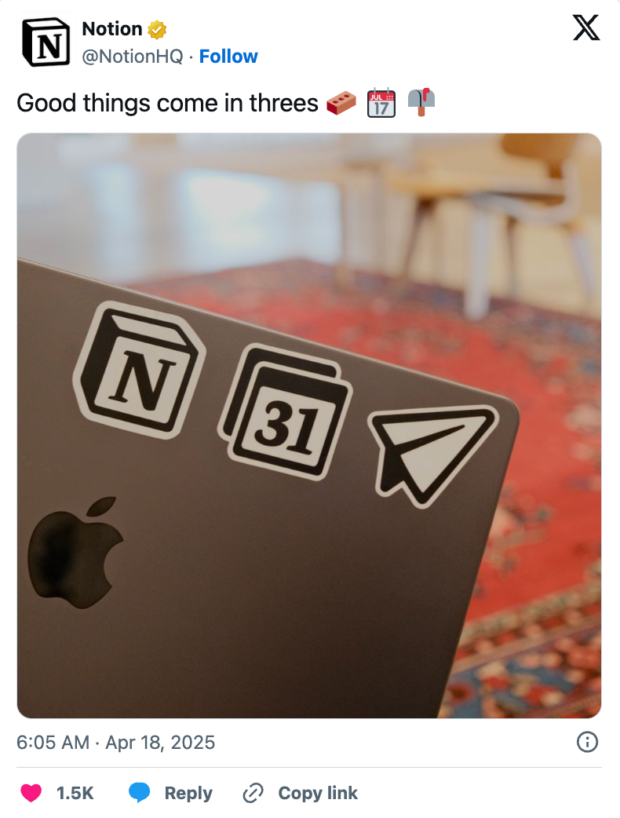
Below is an image Notion shared to its X/Twitter feed of stickers representing its three different products:
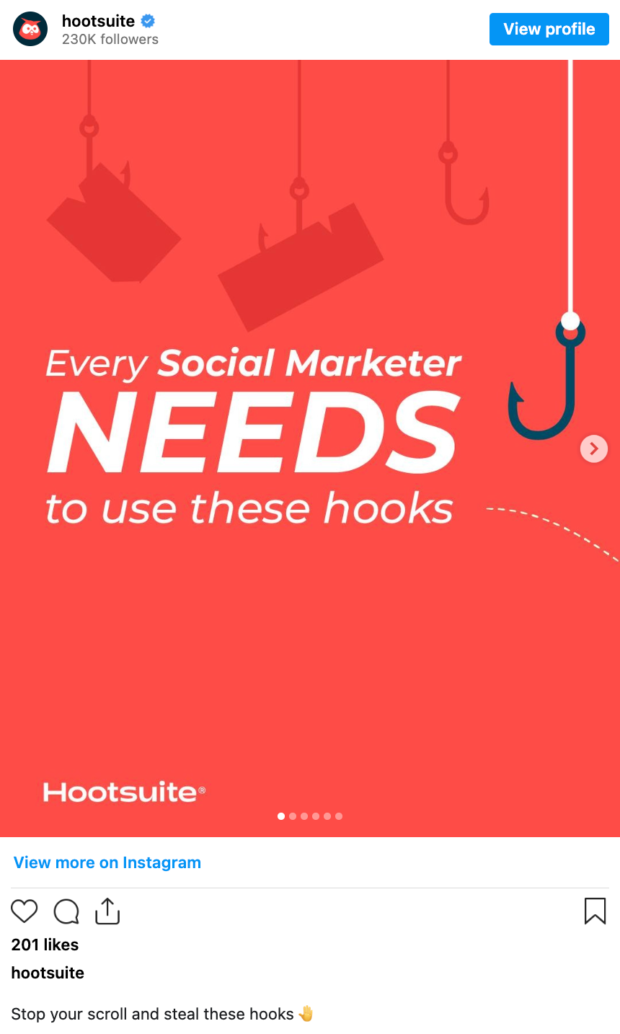
And here, we have another Instagram post from our own account sharing a carousel of graphics with different social media hooks to grab attention:
Each of these posts was shared organically to the brand’s feed so that people who land on your social media profile or are shown your post in their home feed are able to see it.
What are the benefits of organic social media?
The main benefit of organic social media is the ability to build relationships with your audience over time. Organic social media also helps:
Build trust and authority with your audience
Maintain a social media presence without ad spend
Support community engagement and loyalty
Build trust and authority with your audience
Organic social media builds trust because no one wants to feel pummeled by endless online advertisements.
Because organic content isn’t designed to push a conversion, it gives you more room to:
Share opinions and perspectives
Show up in a more authentic, human voice
Build brand awareness over time
As Peter Murphy Lewis, Fractional CMO at Strategic Pete, puts it, “Organic is where your voice, values, and vibe come through. It’s where your audience says, ‘I like how this brand thinks.’ It creates that layer of trust.”
TL;DR: Showing up consistently helps people see your brand as more than just a transaction, and that’s what keeps them coming back.
Maintain a social media presence without ad spend
One of the biggest advantages of organic social media is that it doesn’t require an advertising budget. Anyone can create a social media account and start posting with free social media tools and no upfront costs.
That doesn’t mean it’s effortless. Organic social still takes time and consistency, but the payoff compounds. Organic content can:
Continue generating engagement long after you hit “publish”
Reach new audiences organically through sharing or algorithmic discovery
Grow in value as your following increases
As Brian Futral, Founder and Head of Content at The Marketing Heaven, says, “Organic social isn’t just cheap, it’s sticky. That’s the long game.”
“When audiences see a brand consistently showing up on their terms, with a real voice, and without an aggressive CTA, it builds something money can’t buy: emotional residue,” he adds.
And while paid social is often easier to measure and predict, organic content still has something ads don’t: the chance to take off on its own and reach audiences you never could have imagined.
Support community engagement and loyalty
Organic social media helps you to build an engaged and loyal audience. Through comments, replies, and direct messages, you can:
Build ongoing conversations with followers
Encourage repeat engagement
Create a real sense of community around your brand
Shanté Gorman, Founder at Sugarpunch Marketing, explains, “I’ve found that nothing beats organic social for building real connections with your audience. There’s something special about the trust and loyalty that develops when people engage with content that isn’t obviously promotional.”
Gorman adds, “In my experience, these authentic interactions create a community feeling that paid efforts just can’t replicate on their own.”
By consistently showing up, sharing organically, and responding to your audience, you can turn passive followers into loyal customers — and, over time, real advocates for your brand.
What are the challenges of organic social media?
The main drawbacks of organic social media are slow growth and limited reach. Algorithms prioritize paid content, so even strong organic posts may only reach a fraction of your followers. Let’s dive into its challenges below:
Growth is slow
Organic social media is slow to scale. It relies on consistency, repetition, and long-term audience building, which means results build gradually, not overnight.
Futral explains, “Organic growth takes forever to gain momentum. You can post five times a week, craft perfect captions, ride trends, even sprinkle memes, and still, reach crawls at a snail’s pace.”
It’s no secret: organic content is a grind. But small efforts add up, and eventually your growth becomes quicker.
Limited reach due to algorithms
Most social platforms give priority to paid content, which means organic posts are often shown to only a small portion of your existing followers.
As a result:
Even strong content can get limited visibility
Reach can fluctuate from post to post
Brands have little control over who sees organic posts
The upside? This is where paid social can support organic. When a post is performing well but not getting the reach it deserves, adding ad spend can help it reach the right audience without starting from scratch.
What is paid social media?
Paid social media is content that a person or brand pays to promote. It includes boosted posts, feed and Stories ads, sponsored content, and paid influencer partnerships.
Unlike organic reach, which the algorithm controls, paid reach is bought directly. Brands set the budget, the targeting, and how often an ad appears.
Examples of paid social media activities include:
Boosting posts to reach audiences beyond your followers
Running targeted ad campaigns based on demographics, interests, or behavior
Promoting events, products, or services through sponsored posts
Partnering with influencers and creators through paid collaborations
Paid social media advertising keeps getting more crowded. US social media ad spending is expected to grow 15.6% in 2026, reaching $124.88 billion (EMARKETER December 2025 forecast). Globally, that figure is projected to reach US$338.75 billion in 2026.
At the same time, this also means people are seeing ads more than ever — which is why organic social still matters alongside paid.
First, we have an Instagram ad from ecommerce company Estelle Colored Glass.
This ad is promoting a couple of styles that the company won’t be making anymore, drumming up interest and creating a sense of urgency for people who want to be sure to grab those styles before they can’t anymore.
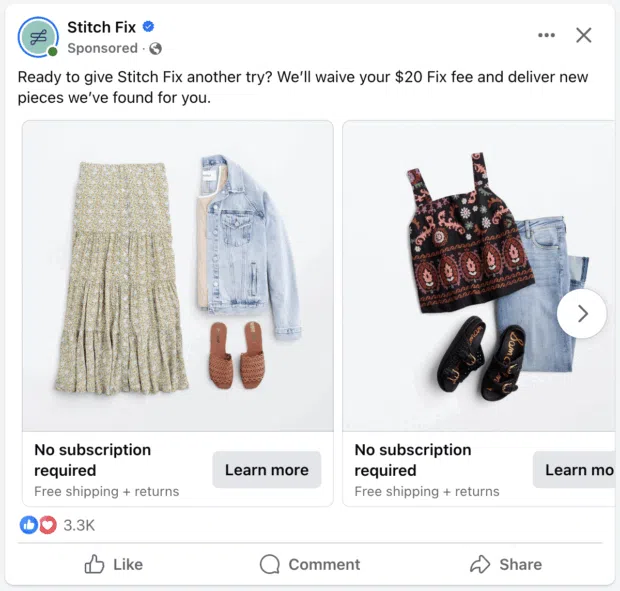
Next is a Facebook ad from clothing subscription brand Stitch Fix. The brand used a carousel ad format to showcase different outfits viewers could create by restarting their subscription, a tactic designed to create intrigue and drive conversions.
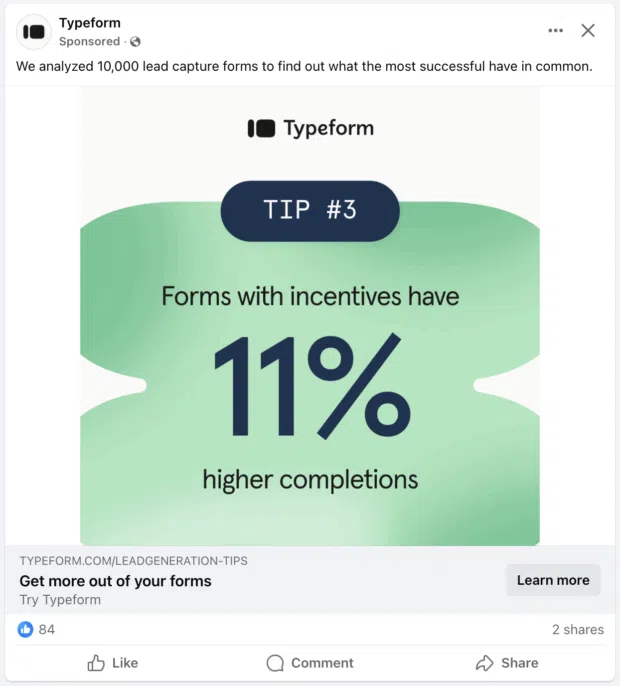
And finally, we have a Facebook ad from Typeform sharing tips for creating successful forms. This ad is meant to generate clicks and traffic to the company’s website, leading users to a blog post with even more lead generation tips.
Each of these ads serves its own purpose, aligning with the company’s business goals — whether it’s to generate awareness, traffic, or revenue.
What are the benefits of paid social media?
The main benefit of paid social media is the ability to reach specific audiences at scale and drive results quickly.
In addition, paid social media:
Allows advanced ad targeting
Has clear ROI
Is easy to track
Allows advanced ad targeting
Paid social media allows brands to control exactly who sees their content through precise targeting. You can choose to show your paid ads to people in a specific age bracket, location, and even niche down further to target specific behavior types (shops at a grocery that sells your product, for example).
You can also run retargeting ads that put your business in front of potential customers who are already considering buying your product.
Gorman says, “The targeting capabilities of paid social are honestly why we use it so much.”
“For example, we could reach 35-year-old dog owners in Seattle who like camping and have recently bought outdoor gear. This level of precision helps ensure you’re not wasting resources on people who aren’t interested in what you offer,” she adds.
Has clear ROI
Unlike organic social media, paid advertising campaigns are designed to deliver results quickly. Performance for individual ads is constantly tracked and recorded, showing you exactly how much you paid for every click, sale, and lead.
From there, all you need to do is choose the social media platform that gives you the best return on investment. Audience reach varies widely, since 84% of US adults use YouTube while half use Instagram. Slowly improve and optimize your ads based on the data you collect.
Is easy to track
All social media platforms offer basic ads tracking and analytics.
Facebook and Instagram have the Meta Business Suite, X/Twitter has X Ads and Analytics, LinkedIn has LinkedIn Ads and Analytics, and TikTok has TikTok Ads Manager and Analytics.
If you want to take your data even further, third-party tools like let you track your paid social media efforts across platforms and manage all of your data from a single dashboard, with detailed reporting you can act on.
What are the challenges of paid social media?
The main challenges of paid social media are cost, ongoing maintenance, and audience fatigue. None of these are dealbreakers, but they do shape how much budget and staffing you need to make paid work.
Can be expensive
Paid social media has the potential to get expensive, and quickly. To keep costs down, you need to be strategic about your ad spend and consistently monitor your ad performance so you’re not overspending.
Requires continuous optimization
Paid social media isn’t a “set it and forget it” strategy. To perform well, paid campaigns typically require:
Regular performance reviews
Creative refreshes
Audience and targeting adjustments
Social media teams need a dedicated team member whose sole responsibility is creating, optimizing, and analyzing paid ad campaigns. This is yet another expense that paid social media can cost your business.
Ad fatigue
Another major drawback is ad fatigue, or the idea that people are being advertised to so often that they quickly lose attention. The imbalance is growing: social media’s share of time spent with media is expected to peak in 2026, even as ad spending on these platforms keeps climbing.
As Gorman puts it, “I’ve noticed that as soon as people get a whiff that something is an ad, they tune out immediately. The dreaded ‘sponsored’ label can be a kiss of death for engagement.”
Organic vs. paid social media: how do they differ?
Organic social media builds long-term trust with your existing audience, while paid social media buys immediate reach and measurable results. The differences show up most clearly in cost, timeline, and how long a post keeps working for you. Here’s how they compare:
Category
Organic social media
Paid social media
Goal
Building relationships and brand trust
Driving brand awareness, traffic, leads, and conversions
Best used for
Sparking engagement and showcasing brand personality
Boosting top posts, promoting launches, and reaching new audiences
Reach
Limited to followers and algorithm-dependent
Scales with budget and targeting
Cost
Free, but requires consistent time and effort to create content
Requires ongoing ad budget
Audience
Your existing followers and the people they reach
Precise audience targeting based on demographics, behavior, interests
When should you invest in organic vs paid social media?
Lead with organic when you’re building a foundation, and bring in paid when you need reach, speed, or precision. Most teams don’t choose one over the other, they shift the balance depending on the goal in front of them.
Use organic social media when you want to:
Build brand awareness over time: Consistent posting compounds, even on a small budget
Nurture an existing community: Comments, replies, and DMs are organic territory
Test content themes cheaply: Organic tells you what resonates before you spend
Support customers: Service and answers belong in your feed and inbox, not an ad
Work with limited or no ad budget: Time and consistency substitute for spend
Use paid social media when you want to:
Launch a product or campaign: You need reach on day one, not month three
Promote a time-sensitive offer: Sales, events, and registration deadlines can’t wait for the algorithm
Reach a new audience segment: Targeting puts you in front of people who don’t follow you yet
Drive conversions and retarget: Paid reaches people who already browsed or abandoned a cart
Prove measurable results fast: Cost per lead and ROAS are reportable within days
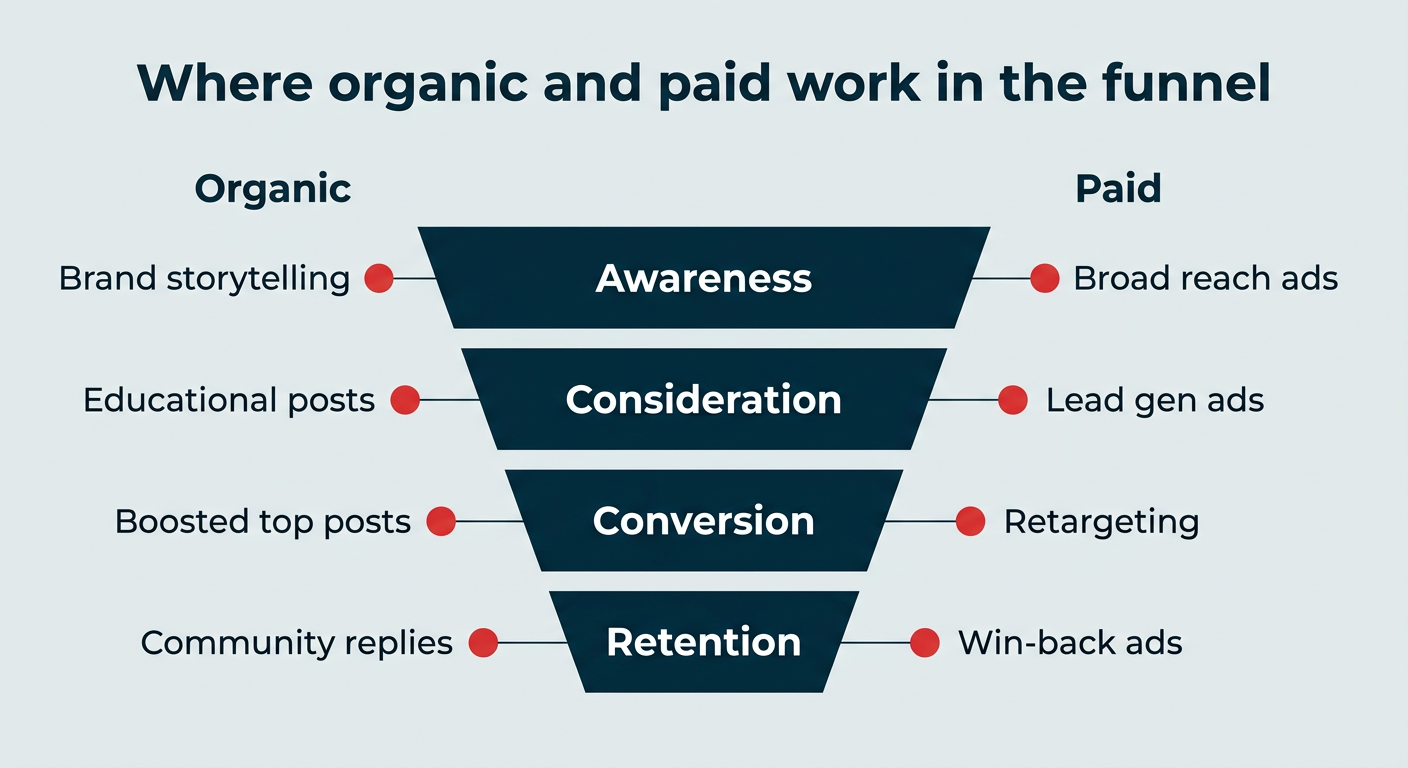
It also helps to think about where each one sits in the funnel. Organic tends to do its best work at the top and middle, building awareness and consideration, while paid can operate across the whole journey but earns the most at the bottom, where conversion and retargeting live.
How to combine organic and paid social media: 6 expert tips
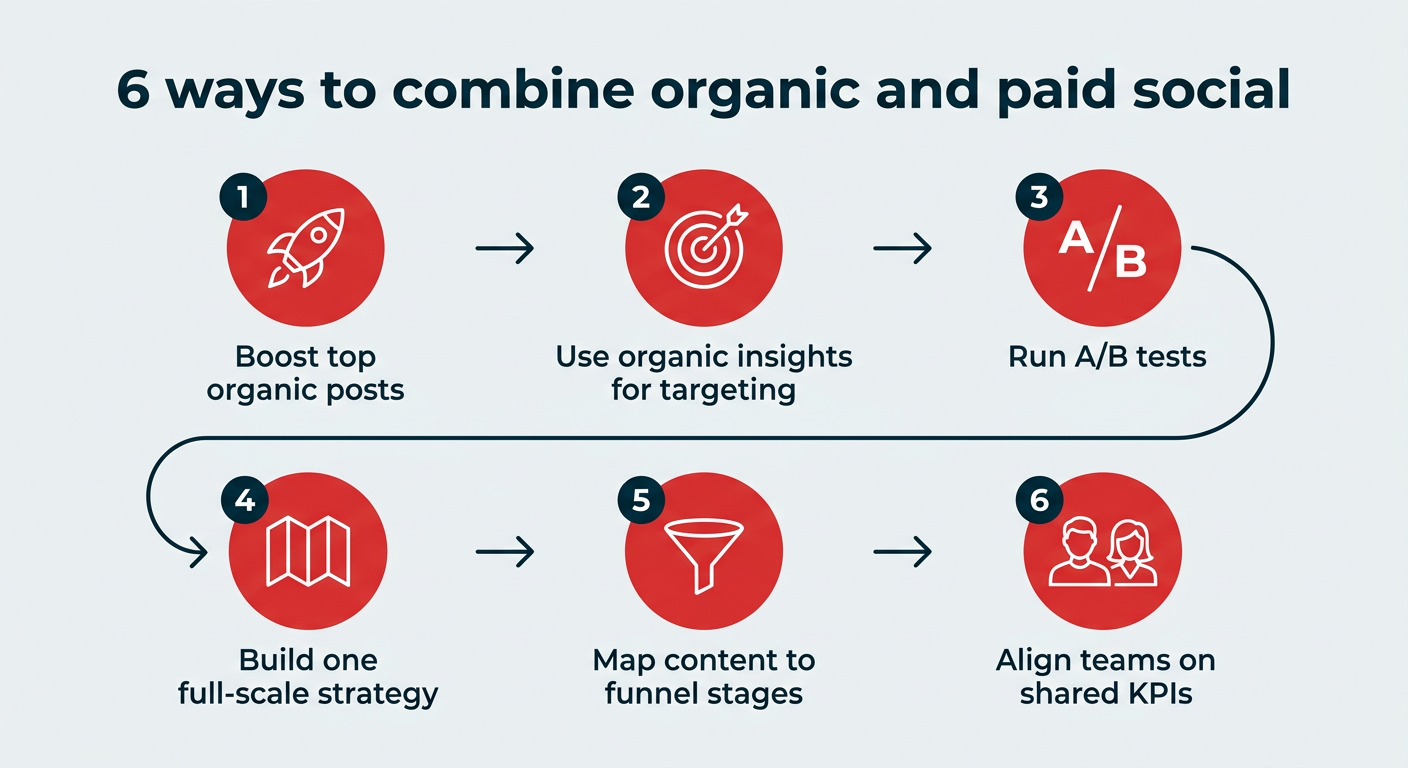
The best way to combine organic and paid social is to use organic to find what works, then use paid to scale it. Here’s how to create a hybrid approach, according to the experts:
6 ways to combine organic and paid social
Boost your top organic posts
Use organic insights to inform paid targeting
Run A/B tests
Create a full-scale strategy
Map organic and paid to funnel stages
Align your teams on shared KPIs
1. Boost your top organic posts
One of the easiest ways to connect organic and paid efforts is to put ad spend behind posts that already perform well organically.
This is generally considered an entry-level tactic because it’s low-risk. You don’t need to come up with an ad, let alone an ad campaign.
Gorman explains, “It’s like getting the best of both worlds — content that feels natural and authentic to the platform but with the targeting muscle of paid promotion.
It also tends to outperform purpose-built ads: a post that already earned organic engagement comes with proof it resonates, and boosting just extends that reach.
Start by allocating a small budget to the top weekly or monthly post whenever you run your analytics report. Don’t just pay attention to likes, but also conversions and profile views.
Pro tip : With Perch’s Boost tool you can customize triggers to automatically boost posts that are snowballing (for example, whenever your post gets shared 100 times).
2. Use organic insights to inform paid targeting
Organic performance data can act as a testing ground for paid strategy.
Murphy Lewis tells us, “We always test content themes on LinkedIn or Instagram Reels first. If a post gets traction organically, it becomes the blueprint for our paid campaigns.“
For example, if you test a new type of content as a part of your social media content strategy — like using Instagram Reels instead of static posts — and it performs well organically, you can start to incorporate some of those same assets into your paid ads.
Kris Flank, CEO of LunarLinks, agrees: “Utilize paid to enhance what’s already building momentum organically. What you won’t be doing is speculating — you’ll be investing in content that people have already indicated that they’ll be interested in.”
3. Run A/B tests
Before you allocate your entire social media budget to an ad, run versions of it by a smaller audience to see what lands.
Testing can include:
Copy and creative formats
Calls to action
Audience segments
Placements across platforms
The benefit here is twofold: your ads feel more memorable for your audience, and they usually cost less for you.
Paid social media campaigns drive reach, traffic, and conversions
Insights flow between both to improve results
As Jason Pack, CRO at Freedom Debt Relief, puts it, “Paid and organic work best hand-in-hand. You should run ads to drive sales and use organic content to build trust, engagement, and long-term loyalty.”
5. Map organic and paid to funnel stages
Thinking full-funnel stops organic and paid from doing the same job twice. Map your content types to the stage they’re actually built for, then let each channel play to its strength:
Awareness: Organic brand storytelling, trend-driven Reels, employee advocacy, and UGC, supported by broad paid reach campaigns
Consideration: Organic educational posts, product demos, customer stories, and community replies, supported by paid traffic and lead gen ads
Conversion: Paid retargeting, offer-driven ads, and boosted posts that already proved they resonate
Retention and loyalty: Organic community engagement, DMs, and customer support, with occasional paid win-back campaigns
Once content is mapped this way, it’s much easier to see gaps in your mix. If every post you publish sits at the awareness stage, your paid budget is probably carrying the entire conversion load on its own.
6. Align your teams on shared KPIs
Organic and paid often sit with different people, different tools, and different definitions of success. That’s how you end up with one team celebrating engagement growth while the other reports a rising cost per acquisition, with no shared view of what happened.
A few shared KPIs that keep both teams pointed at the same outcome:
Total social-attributed revenue: Conversions credited to social overall, not split by channel
Blended cost per acquisition: Ad spend plus content production cost, divided by total conversions
Audience growth rate: Net new followers and reach from organic and paid combined
Engagement rate on boosted content: A shared signal that creative is working, not just that targeting is
Set a cadence to review these together, even if it’s a 30-minute monthly check-in. Shared numbers make it much harder for either team to optimize in a direction that quietly hurts the other.
How to measure organic and paid social media together
Measuring organic and paid together means matching metrics to each channel’s job, then rolling both up into a view of business impact. Reporting them in separate decks is the fastest way to lose the connection between the two.
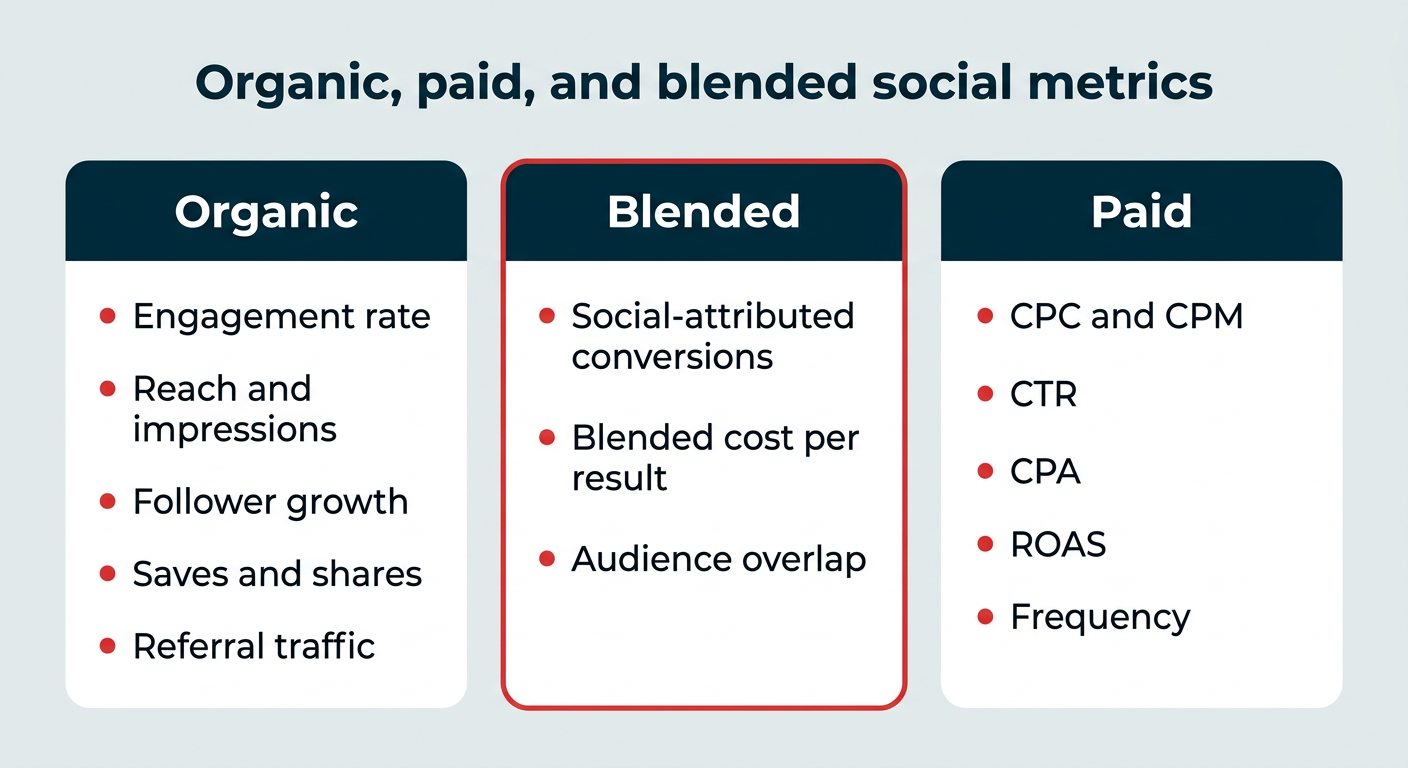
Core organic metrics to track:
Engagement rate: Interactions relative to reach or followers
Organic reach and impressions: How far content travels without spend
Follower growth: Net new audience over a set period
Saves and shares: The strongest signals that content is worth boosting
Organic referral traffic: Sessions and conversions from social links
Core paid metrics to track:
CPC and CPM: What you’re paying for clicks and impressions
CTR: Whether your creative and offer are landing
CPA: Cost to acquire a lead or customer
ROAS: Revenue returned per dollar of ad spend
Frequency: An early warning sign for ad fatigue
Blended metrics are where the two channels finally talk to each other. Total social-attributed conversions, blended cost per result across organic and paid, and audience overlap between your follower base and your ad targeting all tell you whether your spend is reaching new people or re-reaching the ones you already have.
The practical move is to view organic and paid performance side by side in one report, over the same date range, tied to the same business goal. That’s when patterns show up: the organic post that quietly drove the cheapest conversions, or the campaign that scaled reach but never moved revenue.
How to manage organic and paid social media with Hootsuite
When your organic and paid strategies operate separately, it’s tough to get a complete picture of what’s working and what’s not. That’s where Perch by Hootsuite comes in.
With Perch, you can manage all your paid content alongside your organic social posts, so you can move quickly and capitalize on new opportunities before they slip away. Here’s how it helps:
A single advertising dashboard
Perch brings your advertising work into one place. You can publish, manage, analyze, boost, and report on ads from one connected workflow, instead of switching between platforms and tabs to piece together what happened.
Cross-channel publishing and planning
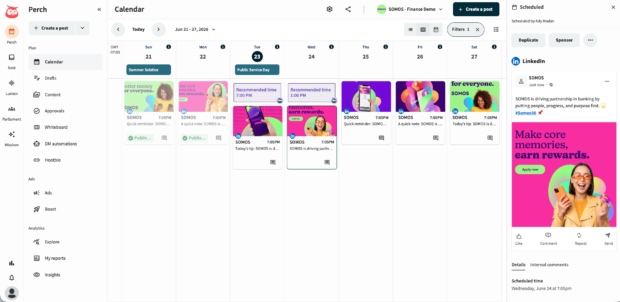
Perch lets you craft and schedule your posts, organic and paid, for LinkedIn, Facebook, and Instagram at the same time, from one calendar.
Whether you’re targeting new customers or promoting a specific campaign, Perch’s Composer makes it easy to create content that resonates with your specific audience.
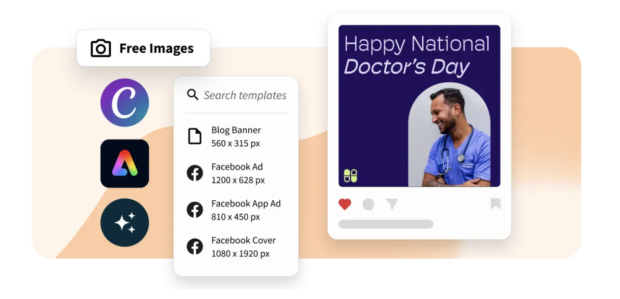
Plus, built-in Canva and Adobe Express integrations let you design and edit visuals without leaving Perch.
Meet the Suite
Understand what matters, decide what to do next, and take action across every social workflow — all from one connected suite.
With organic reach on the decline, boosting posts has become a key strategy for expanding your content’s reach on social media.
When you boost a post, you extend its reach beyond your followers, reaching a wider audience. You have the flexibility to choose your campaign goal, target audience based on demographics, location, and interests, set your budget, and determine the duration of the promotion.
With Perch’s boosting feature, you can optimize your ad spend by targeting the right audience based on geographic and personal characteristics. Tailor your promotions to specific demographics, interests, and locations to ensure your content resonates with the right people.
Boosting is available for Facebook, Instagram, and LinkedIn, allowing you to extend the reach of your posts to new audiences.
Side-by-side analytics and reporting
Analytics is where the magic happens. Perch lets you review both organic and paid content side by side, giving you valuable insights into what’s working and what’s not.
By filtering campaign metrics and pulling data from your organic content, you can optimize your paid strategy and vice versa. You can also build in-depth reports and schedule automated email delivery, so reporting stops eating into strategy time.
Insights and AI-powered answers
Inside Hootsuite Social OS, Lumen surfaces the listening and audience insights that shape both sides of your strategy, from the conversations worth joining organically to the themes worth putting budget behind. Wisdom lets you ask questions about your performance in plain language, so you can get to the “why” behind a result without building a report first.
FAQ: Organic vs paid social media
What is the difference between organic and paid social media?
The main difference between organic and paid social media is cost and reach. Organic social media is the free content a brand posts to build relationships and trust, and its reach is limited to followers and the people they share with. Paid social media is content a brand pays to promote, so it can reach a larger, precisely targeted audience based on budget and targeting. In short, organic earns reach over time, while paid buys it instantly.
When should businesses use organic social media vs paid advertising?
Businesses should lead with organic social media to build trust, community, and brand awareness, and turn to paid advertising when they need fast, measurable results. Organic is the smart starting point because it is free and reveals what content resonates, and it tends to do its best work at the awareness and consideration stages. Paid works best once that groundwork exists, when a goal is time-sensitive such as a product launch, event, or sale, or when you need bottom-funnel conversions and retargeting.
How do enterprises balance organic and paid social media strategies?
Enterprises balance organic and paid by running them as one integrated strategy rather than two separate channels. Organic content builds trust and tests what resonates, and paid scales the posts that already perform. In practice, that means aligning both teams on brand voice and visuals, using organic engagement data to guide paid targeting, and putting ad spend behind top organic posts instead of building ads from scratch.
Organic vs paid social media: which delivers better ROI?
Neither organic nor paid delivers better ROI on its own, because they measure return differently and work best together. Paid social media delivers faster, directly measurable ROI through clicks, leads, and conversions tied to ad spend. Organic social media delivers compounding, longer-term ROI by building trust and loyalty, though it is harder to measure. The clearest answer comes from blended measurement: look at total social-attributed revenue and cost per result across both, then use organic to find what works and paid to scale it.
How do brands measure success across organic and paid social campaigns?
Brands measure success by matching metrics to each channel’s goal and then connecting both to business outcomes. Organic performance is tracked through engagement, reach, follower growth, comments, and DMs, while paid performance is tracked through conversions, click-through rate, cost per result, and return on ad spend. Review organic and paid metrics side by side over the same date range and tie them to revenue. A platform like Perch by Hootsuite makes this easier by tracking organic and paid performance in a single dashboard.
What is organic reach, and why is it declining?
Organic reach is the number of unique users who see your content without paid promotion, and it has been declining steadily as platforms prioritize paid content and personal connections in their algorithms. More brands are competing for a finite amount of feed space, and recommendation-based feeds now favor content the algorithm predicts will perform rather than content from accounts users already follow. The practical response is to create content people genuinely want to engage with, then put budget behind the posts that already prove they resonate.
What is the 5 5 5 rule for social media?
The 5 5 5 rule is a social media engagement framework where you spend five minutes liking five posts and leaving five meaningful comments to build organic visibility and community connections. It is a daily habit rather than a strategy, and it works because algorithms reward accounts that participate in conversations, not just publish into them. For brands, it is a low-cost way to stay visible between posts.
Is paid social media less effective than organic reach?
Paid social media is not less effective than organic reach; the two serve different purposes and perform best when used together. Paid is more effective at reaching new audiences quickly and driving measurable conversions, while organic is more effective at building trust, loyalty, and long-term brand affinity. Comparing them head to head usually means comparing different goals.
What is organic in social media?
Organic in social media refers to any content a brand or person posts on social platforms without paying to promote it, including posts, Stories, Reels, comments, and community replies. Its reach depends entirely on the platform algorithm and how people choose to engage with and share it. Organic activity also covers employee advocacy and resharing user-generated content.
How much should you spend on paid social media?
How much you should spend on paid social media depends on your goals, industry, and audience size, but a common starting point is to allocate a defined share of your total marketing budget to paid social and adjust based on performance. A practical approach is to start small, boost posts that already perform organically, track cost per result, and scale spend only once you have a repeatable cost per acquisition you can live with.
Save time managing your social media marketing strategy with Hootsuite. Publish and schedule posts, find relevant conversions, measure results, and more â all from one dashboard. Try it free today.


 : With