Social media SWOT analysis: A 2026 guide with template
Key takeaways
- A social media SWOT analysis evaluates your performance across four areas: strengths, weaknesses, opportunities, and threats, so you can make strategic decisions grounded in data.
- Run one when you’re planning budgets, launching campaigns, conducting your annual audit, or responding to a sudden shift in sentiment.
- The most useful analyses combine internal performance data with external signals like competitor activity, industry benchmarks, and platform changes.
- This guide includes step-by-step instructions, concrete examples for each quadrant, and a ready-to-use template.
What is a social media SWOT analysis?
A social media SWOT analysis is a framework marketers use to evaluate their social media performance by looking at four areas: strengths, weaknesses, opportunities, and threats.
Here are a few scenarios where a social media SWOT analysis could come in handy:
- Deciding whether to join a new social media platform
- Rebranding or repositioning
- Making budget decisions
- Planning campaigns
- Identifying emerging trends
In short, a social media SWOT analysis helps you make smarter decisions about where and how to invest on social. It also keeps your strategy grounded in real data, not guesswork.
What are the components of a social media SWOT analysis?
There are four components, and each one maps to a different type of insight:
- Strengths: What your brand is doing well on social media, like strong engagement, high follower count, or consistent branding. Example: your Instagram Reels consistently outperform your static posts, or your community responds fast to every product drop.
- Weaknesses: Areas where your brand could improve, from inconsistent posting to off-target messaging. Example: no presence on an emerging platform your audience already uses, or slow response times in your inbox.
- Opportunities: External factors that give your brand a chance to grow, like emerging trends or new platform features. Example: a rising keyword in your category, or a new video format with an early-adopter boost.
- Threats: External risks that could hurt your performance, like algorithm changes or increased competition. Example: a rival brand launching on a channel you’ve deprioritized.
Strengths and weaknesses look at internal factors you can control, while opportunities and threats focus on external factors. These things happen outside of your control (but you still need to monitor and respond to them).

How is a social media SWOT different from a traditional SWOT?
A social media SWOT pulls from different data than a traditional business SWOT. Instead of market share, revenue, and supply chain factors, you’re working with platform metrics, social listening signals, and competitive benchmarks that update daily.
Speed is the other difference. Social platforms shift faster than most business environments, so a social media SWOT needs revisiting quarterly rather than once a year.
Why run a social media SWOT analysis?
A social media SWOT analysis helps you see the bigger picture, so you can see what’s working, what’s not, and decide what to do next.
Here’s why you should conduct a social media SWOT analysis:
Set impactful (but realistic) goals
For goals to be effective, they need to be ambitious but achievable. A social media SWOT analysis helps you understand what’s actually possible by combining your past performance with industry benchmarks.
In other words, a SWOT analysis grounds your goal-setting in both internal data and external reality. That’s how you set business goals that actually hold up.
We’ve got separate blog posts to help you with the details of setting SMART goals and social media KPIs.
Identify and mitigate risks
Weaknesses and threats might sound scary. But taking a good, hard look at these areas will help you prepare for potential curveballs.
Weaknesses reveal internal risks related to process, tools, and teams. Threats point to external challenges like algorithm shifts, compliance issues, or economic changes.
For example, a recent study found that about 80% of people agree that media organizations must be transparent about their use of AI, and 53% worry about how personal data is collected and used.
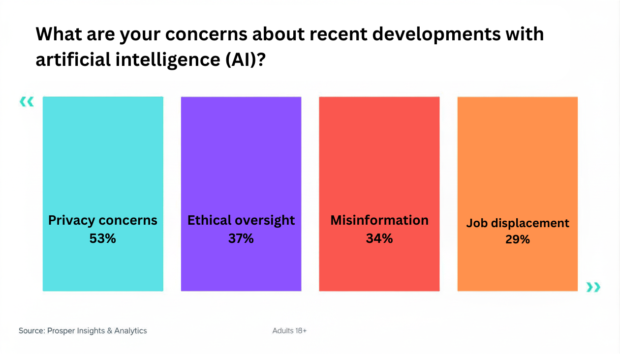
Source: Forbes
How does that impact a social media SWOT analysis? It highlights the need for transparency, and gives you a chance to put guardrails in place, like labeling AI-generated content or setting clear standards for how AI gets used.
Risk management is an important part of your social media strategy. A SWOT analysis makes sure you’re focusing on the right risks at the right time.
Stay competitive
A social media SWOT analysis forces you to think beyond your own brand bubble. It considers the broader landscape — where US social ad spending exceeds $120 billion — and upcoming changes, so you’re always a step ahead.
Most of the time, that means watching how competitors move. If a rival brand starts gaining share of voice on a platform you’ve deprioritized, or picks up a trending format before you’ve tested it, that shows up in your SWOT as a threat long before it shows up in your engagement numbers.
Timing matters too, especially around commerce moments. NRF’s holiday survey found that 42% of shoppers plan to begin their holiday shopping before November, which means your social calendar needs to move earlier to reach them.
Payment behavior is shifting in the same direction. Buy Now, Pay Later (BNPL) transactions hit a new high in 2025, driving over $1.03 billion in online sales on Cyber Monday alone. If competitors are promoting flexible payment options in their social commerce content and you aren’t, that’s a gap worth logging.
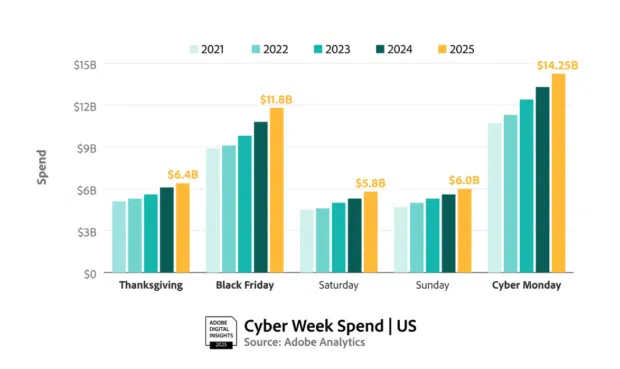
Source: Adobe Analytics
Allocate resources effectively
An internal social media analysis only considers the strategies you already use. That’s a good starting point for figuring out how to allocate your social media resources. But it misses all the strategies you haven’t tried.
A SWOT for social media takes things further by incorporating data from beyond your organization.
Short-form video is the clearest current example. Wyzowl’s 2026 video marketing research found that 93% of video marketers say video has helped increase brand awareness.
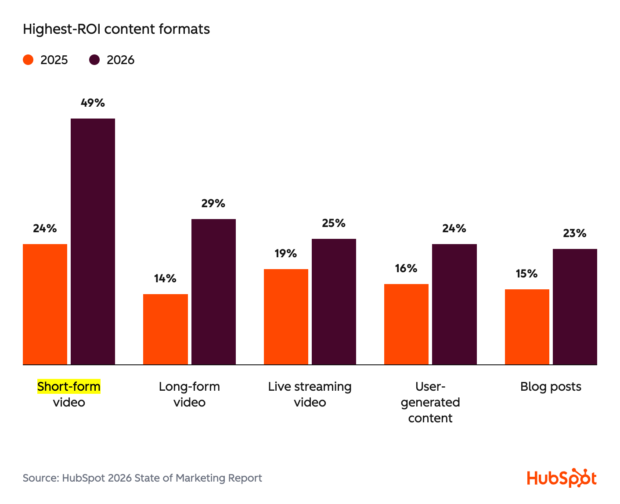
That doesn’t mean short-form social videos will provide the best ROI for you specifically, but it’s an indication that you should make room in your content strategy to test it out.
Get a clearer picture of your performance
You already use social analytics to understand your performance and report to stakeholders. But reporting in a bubble can give you a false sense of the possibilities.
Conducting a SWOT analysis includes external data like industry benchmarks and competitor research. This reveals the true level of your success compared to your peers.
The insights don’t stop at marketing, either. Social media is often where customer issues show up first, so patterns in your weaknesses and threats are usually worth sharing with product and customer support teams.
When should you run a social media SWOT analysis?
You should run a social media SWOT analysis when it’s time to make strategic decisions, such as planning budgets, launching campaigns, or conducting performance audits.
Here are the most common times to run a SWOT analysis:
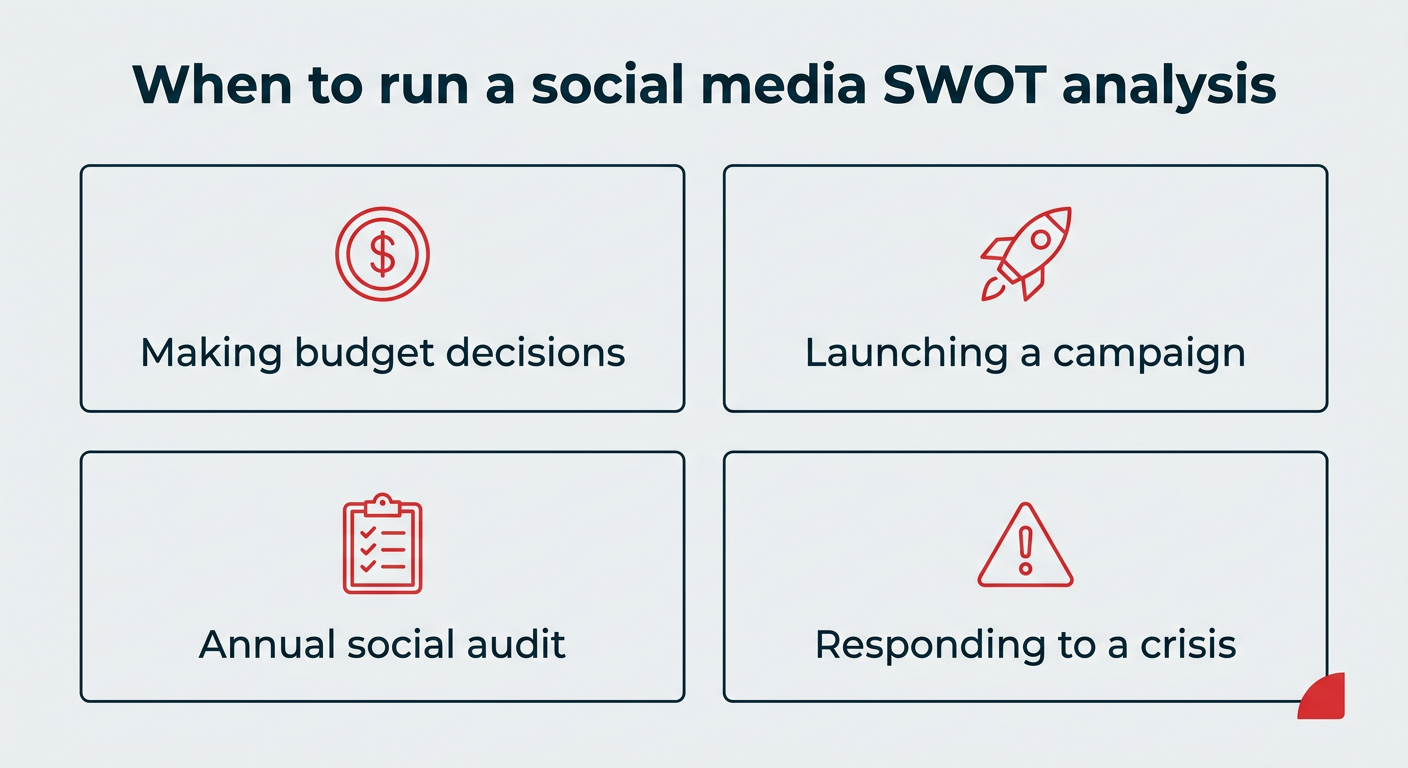
Making budget decisions
A detailed SWOT analysis can help you anticipate new strategies or features as you plan your annual budget, which matters when marketing budgets sit at just 7.8% of company revenue. It can also help identify opportunities to reallocate resources more effectively. All of this works to maximize ROI.
Launching a new campaign
Before you launch a new campaign, it’s important to look back at what has worked well — and not so well — in the past. This applies to both your own campaigns and those of your competitors.
You don’t want to copy your competitors’ ideas. But you can certainly learn from their biggest wins and losses.
Your SWOT for social media also makes sure you’re on top of the latest shifts in social culture. This is important for spotting opportunities for new campaign ideas and directions. Be sure to test any new strategies with a small budget instead of making wild swings.
Performing an annual social audit
An annual social media audit is an important strategic check-in. You look at your social accounts, check for necessary changes, review performance, and plan your strategy for the year ahead.
A social media SWOT analysis provides context for your social audit. It helps you evaluate results more accurately and highlight new ways to pivot your social media efforts.
And it goes both ways: your social audit provides detailed information for the internal portions of your SWOT analysis. Social media strategic planning benefits from doing both activities at the same time.
Cross-pollinating the data makes both your SWOT and your audit more effective.
Responding to a crisis or reputation shift
A sudden spike in negative sentiment is another good trigger. When something goes wrong, a SWOT analysis helps you separate the internal causes (a gap in your approval process, an unclear escalation path) from the external ones (a competitor campaign, a wider news cycle).
That distinction matters because it decides what you fix first. Pair this with your crisis management plan so the analysis feeds directly into your response, not just a post-mortem document.
How to run a social media SWOT analysis
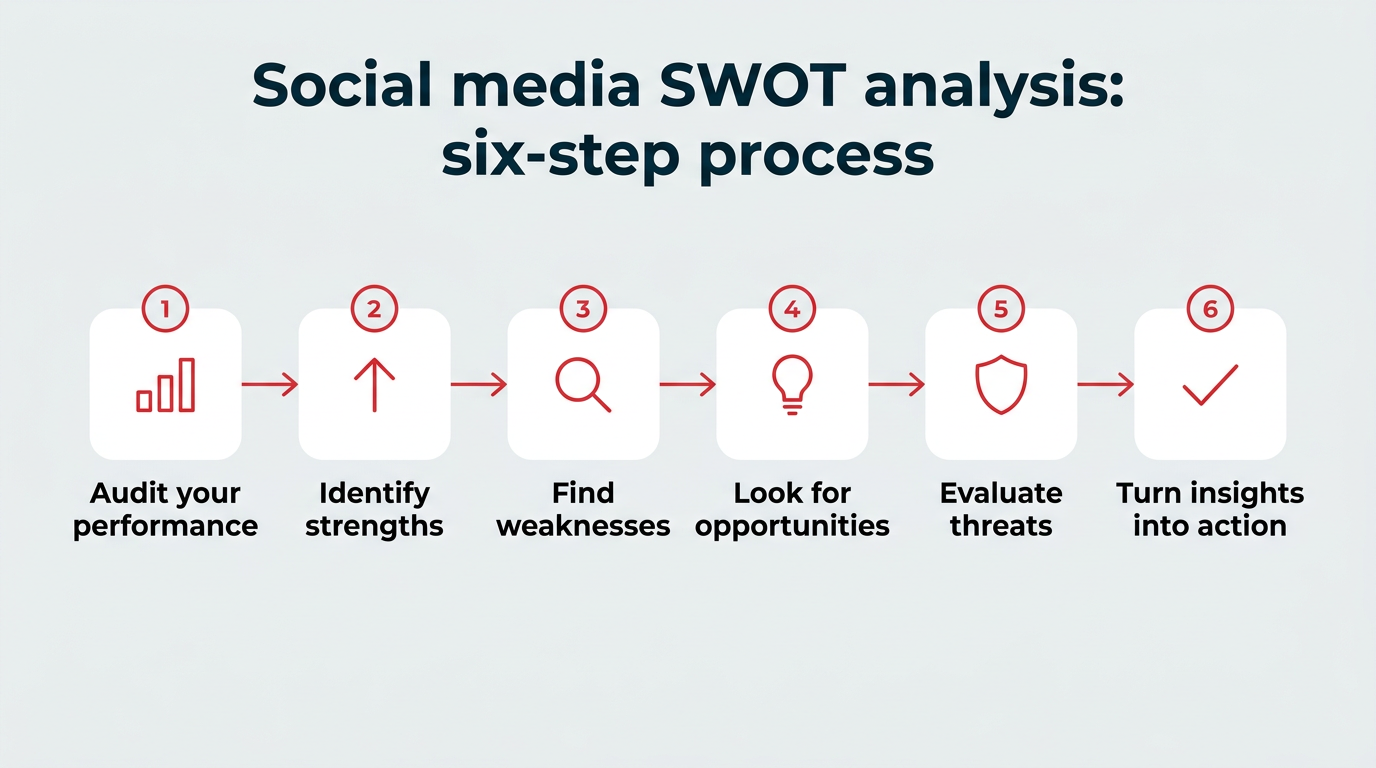
To conduct a social media SWOT analysis, follow these steps:
- Audit your social media performance
- Identify strengths
- Discover areas for improvement
- Look for opportunities
- Evaluate potential threats
- Turn insights into action
1. Audit your social media performance
Start by gathering data on your social media performance. This includes metrics like engagement, follower growth, reach, and conversions.
At minimum, pull the following for every active channel:
- Engagement rate: How your audience interacts with each post
- Follower growth rate: Net audience change over the period, not just raw follower count
- Reach and impressions: How far your content actually travels
- Click-through rate: Whether your content drives people anywhere
- Conversion rate: What happens after the click
- Share of voice: How much of the category conversation belongs to you
- Sentiment score: How people feel when they mention you
Use your social media analytics tools to understand how your content is performing across platforms. Then, look at the competition to see where you stand.
Hootsuite’s industry benchmarking and competitive analysis features are really useful for getting an inside look at your competitors’ performance and how you stack up.
You can see how you compare against your industry based on profile impressions, audience growth rate, and post engagement rate. You can also see how you compare against specific competitors.
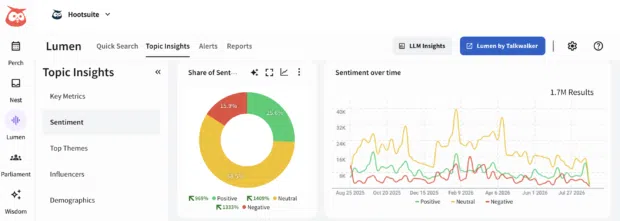
Looking at share of voice and social sentiment is key to understanding how your brand is performing. Lumen, the insights and listening app inside Hootsuite Social OS, surfaces these metrics, giving you a clearer picture of where you stand and how people feel about your brand.

2. Identify strengths
Your strengths are where your social media performance stands out, especially compared to your past results.
Start by reviewing your analytics to see what’s consistently working well. Three questions worth asking:
- Which content formats consistently outperform your industry benchmark?
- Which platforms are growing fastest, and why?
- Where do you see the strongest community engagement, like saves, shares, or comments rather than passive likes?
Don’t forget to compare these metrics against competitors — a competitor tracking template can help structure the comparison. This gives you enough context to see where you have a true competitive advantage.
Pro tip  : Not sure what a good engagement rate looks like for your industry? Check out this guide for the latest benchmarks across 10+ industries, plus a free engagement rate calculator.
3. Discover areas for improvement
Spotting your weaknesses follows a similar process, but with a focus on where performance is falling short.
As always, start with your own metrics. Compare your most recent results with results from previous social campaigns or time periods. Then ask:
- Which platforms show declining engagement quarter over quarter?
- Where is your response time lagging behind audience expectations?
- Are there content gaps your competitors are filling that you aren’t?
Be specific here. For instance, it’s not enough to say you’re falling behind the competition on TikTok. Dig into which content types, formats, or campaigns aren’t delivering.
It’s also important to look at internal factors like budget cuts, team changes, or past social media crises. All of these can impact performance.
A dedicated social analytics tool like Hootsuite provides a full picture of your cross-platform performance. You can see how engagement and conversions fluctuate across your accounts over time.
4. Look for opportunities
To look for new opportunities, you need to keep a pulse on what’s happening outside your brand. That means looking beyond your own data to spot trends in your industry, across social platforms, and in the broader economic/business climate.
Social listening can do a lot of heavy lifting here. It helps to surface trending topics, keywords, and conversations you can tap into. For example, if conversation volume jumps for a specific keyword, that’s an opportunity to create content that’s in demand.
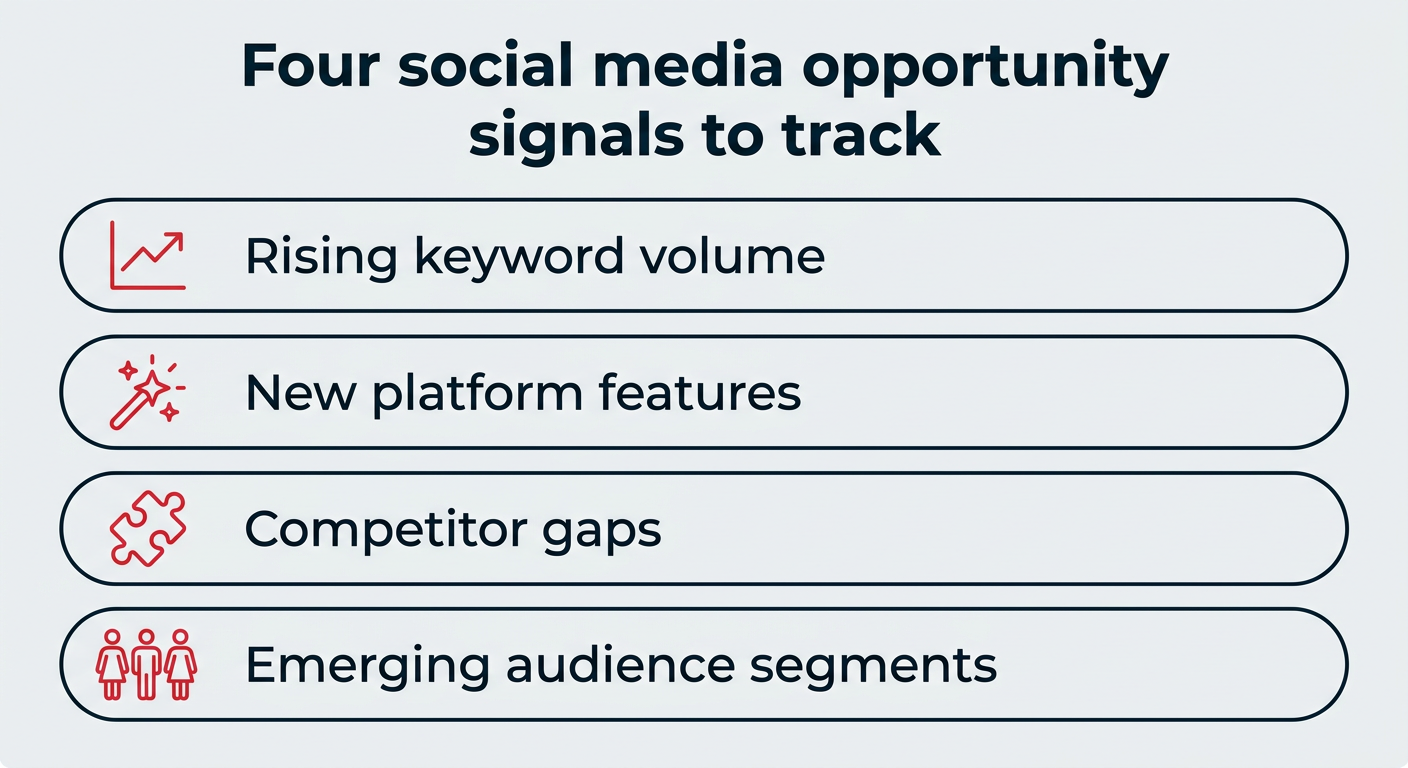
Opportunity signals usually fall into four buckets:
- Rising keyword volume: A topic in your category gaining conversation share
- New platform features: Formats that often carry an early-adopter algorithm boost
- Competitor gaps: Questions your audience asks that nobody in your category answers well
- Emerging audience segments: Audience groups engaging with your content that you haven’t targeted deliberately
Lumen can help you spot trending keywords and broader themes in your niche, both of which can inspire new content ideas.
Monitoring social sentiment is also crucial. For example, going viral on a particular post might look like a strength. But if your social sentiment is overwhelmingly negative, you may have uncovered a weakness in disguise.
Pro tip : Bookmark our 2026 Social Media Marketing Trends Report to know what to expect from social this year.
5. Evaluate potential threats
Just like opportunities, threats are external factors. So, it’s important to evaluate possible changes that threaten your status quo.
The threats worth tracking usually include:
- Algorithm changes: Shifts in what platforms choose to distribute
- New competitor entrants: Brands moving into your category or onto your channels
- Platform policy shifts: Changes to branded content, ad, or API rules
- Audience migration: Your core audience spending more time somewhere you aren’t
- Regulatory changes: Rules affecting data use, disclosure, or advertising in your industry
Most marketing teams know the pain of algorithm changes, so updates need to be on your radar early enough to plan a pivot, like focusing on social SEO.
Social listening can also help you spot emerging risks early — whether it’s a spike in negative sentiment, a competitor entering a new market, or changes in how your audience engages with your content.
Spotting these risks early gives you a chance to respond, like testing new formats, diversifying your content mix, or adjusting your posting frequency.
6. Turn insights into action
Once you’ve filled in your SWOT analysis, the final step is turning those insights into action.
Use your strengths to capitalize on opportunities, and create a plan to address weaknesses and mitigate threats. This might include shifting budget, trying new social platforms, launching new initiatives, or updating internal processes.
A simple way to work through it:
- Prioritize by impact and effort: Start with high-impact, low-effort items so you show progress quickly
- Assign an owner: Every action needs one named person, not a team
- Set a timeline: Tie each action to a specific quarter or campaign
- Convert the top items into SMART goals: A weakness becomes useful once it has a target attached to it
- Book the follow-up review: Schedule it before you close the document
Remember: a SWOT analysis is only valuable if it leads to action. Make sure you use these insights to actually optimize your marketing strategy.
Social media SWOT analysis examples
Seeing a completed grid usually makes the framework click. Here’s what a social media SWOT analysis might look like for a mid-size direct-to-consumer skincare brand.
Strengths (internal, positive) | Weaknesses (internal, negative) |
|---|---|
Instagram Reels engagement rate of 4.2%, roughly double the brand’s own static post average Employee advocacy program contributing a meaningful share of monthly organic reach Consistent brand voice across all four active channels | No active TikTok presence, despite 63% of adults 18-29 using the platform Average first response time in social inbox of 6 hours Paid and organic teams plan content separately, so campaigns rarely reinforce each other |
Opportunities (external, positive) | Threats (external, negative) |
Social listening shows rising conversation volume around a specific ingredient the brand already sells A new LinkedIn video format offers early-adopter distribution for founder-led content Competitors are ignoring post-purchase education content | A key competitor just launched on a platform where the brand has no presence Platform policy changes could reduce organic reach for branded content Rising creator rates are pushing influencer costs above budget |
Example strengths
Strengths should be specific enough to build on. “Good engagement” isn’t actionable, but “Reels at a 4.2% engagement rate, roughly double our static posts” tells you exactly where to put next quarter’s production budget.
Look for repeatable wins: a format that performs regardless of topic, a channel growing faster than the rest, or a program like employee advocacy that reliably extends reach.
Example weaknesses
Weaknesses land better when they’re paired with a number and a comparison. “We’re slow to respond” becomes useful as “our average first response time is 6 hours, and our audience expects a reply the same day.”
Absence counts as a weakness too. Having no presence on a platform your audience actively uses is a gap, even if nothing you’re currently doing is underperforming.
Example opportunities
Opportunities come from outside your account. A 150% jump in conversation volume around a topic you already have authority on is an opportunity. So is a new platform format that hasn’t been saturated yet.
The strongest opportunities usually overlap with an existing strength. If founder-led video already performs for you, a new video format is a faster win than starting from scratch.
Example threats
Threats are the ones teams most often leave vague. Be concrete: name the competitor, the platform, or the policy change, and note what it would actually cost you.
Not every threat needs a response. Log them all, then decide which ones are likely enough and severe enough to plan around this quarter.
Social media SWOT analysis template
Use this template as your starting grid, alongside a step-by-step checklist to make sure you cover every angle. Work through the guiding questions in each quadrant, and answer with specific numbers wherever you can.
Strengths | Weaknesses |
|---|---|
Which content formats outperform your industry benchmark? Which platforms are growing fastest? Where does your community engage most actively? What can you do that competitors can’t? | Which channels are declining, and by how much? Where are response times or coverage gaps hurting you? Which platforms is your audience on that you aren’t? What internal constraints (budget, headcount, tools) limit output? |
Opportunities | Threats |
Which topics are gaining conversation volume in your category? What new platform features could you test first? Which audience questions are going unanswered? Which audience segments are engaging without being targeted? | Which competitors are gaining share of voice? What algorithm or policy changes are on the horizon? Is your audience shifting to a different platform? What regulatory or compliance changes affect your industry? |
Tips for running a better social media SWOT analysis
The framework is simple. The quality of the output depends on how you fill it in. A few things that consistently make the difference:
- Bring in cross-functional stakeholders: Customer support and product teams see patterns your analytics won’t surface, and they’ll often confirm or contradict what you think is a weakness
- Use data, not assumptions: Every entry should trace back to a metric, a benchmark, or a listening report
- Be specific: “We’re bad at TikTok” is a feeling. “Our TikTok engagement rate is 0.8% against a 2.1% industry average” is something you can fix
- Revisit quarterly, not annually: Social moves too fast for a once-a-year document to stay accurate
- Pair it with a competitive review: Your opportunities and threats quadrants are only as good as your view of the wider competitive landscape
3 social media SWOT analysis tools
1. Hootsuite
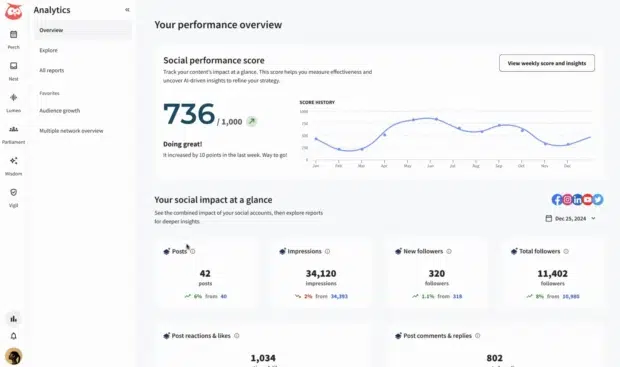
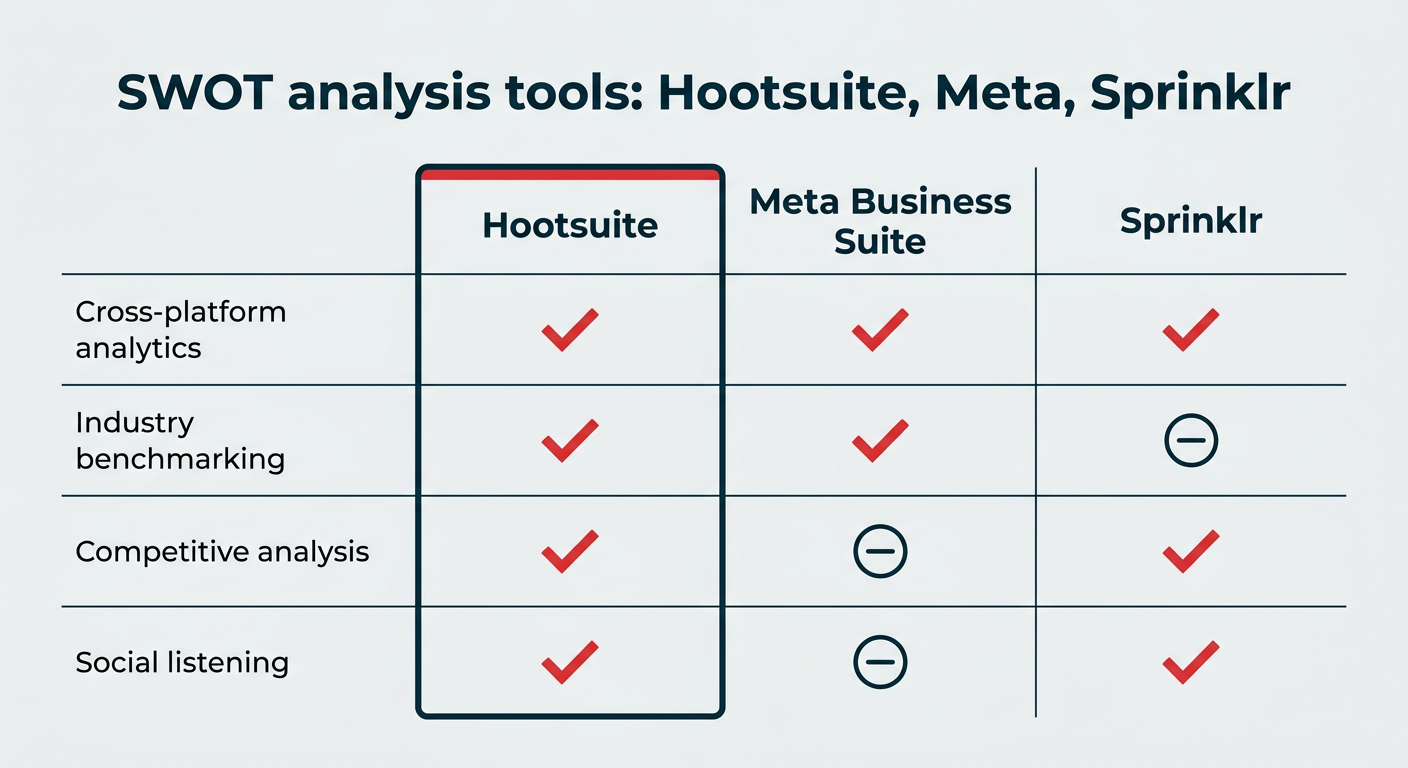
Hootsuite Social OS is a useful tool for running a social media SWOT analysis, since it brings together performance data, industry benchmarks, and competitive insights in one place.
You can see how your results stack up across platforms at a glance. Side-by-side comparisons highlight your strongest channels and content, so you can quickly spot your strengths and weaknesses.
The industry benchmarking tool shows how your results compare to industry averages, while the competitive analysis feature measures your results against up to 20 competitors of your choice.
Plus, Lumen helps you track social sentiment, monitor conversations, and keep an eye on competitor activity across 150+ million sources in 187 languages. That makes it easier to spot emerging opportunities and potential threats as they develop.
2. Meta Business Suite

Meta Business Suite gives you a quick snapshot of your social media performance on Facebook and Instagram with built-in analytics.
It helps you see which platforms and content are driving results, so you can start identifying strengths and weaknesses for your SWOT analysis.
The tool also offers basic benchmarking features, which gives you a bit of external context. Keep in mind that it only covers Meta platforms, so you’ll need more tools to analyze other channels.
3. Sprinklr

Sprinklr offers solid social media analytics and customer insights, which can help you evaluate your strengths and weaknesses. Its brand monitoring and competitive intelligence reports also provide useful context for identifying opportunities and threats.
Sprinklr includes social listening capabilities to help you track trends and conversations. Its data sources are more limited compared to the 150+ million sources Lumen covers across 30+ social channels.
See how Sprinklr compares to Hootsuite.
FAQ: Social media SWOT analysis
What is a social media SWOT analysis and how do businesses use it?
How do companies conduct a social media SWOT analysis step by step?
What factors should be included in a social media SWOT analysis?
How does a social media SWOT analysis improve strategy and performance?
What are examples of effective social media SWOT analyses for brands?
What are 5 examples of strengths in a social media SWOT analysis?
How often should you update a social media SWOT analysis?
What is the difference between a social media SWOT analysis and a social media audit?
How do you identify threats in a social media SWOT analysis?
Can small businesses benefit from a social media SWOT analysis?
Save time managing your social media marketing strategy with Hootsuite. Publish and schedule posts, find relevant conversions, measure results, and more â all from one dashboard. Try it free today.
The post Social media SWOT analysis: A 2026 guide with template appeared first on Social Media Marketing & Management Dashboard.
* This article was originally published here To read more articles like this visit us at yourdigitalmarketingbootcamp.blogspot.com