10 types of social media interactions to master in 2026
Key takeaways
- The 10 types of social media interactions are comments, shares, saves, direct messages, tags and mentions, likes and reactions, follows and unfollows, reviews and ratings, social search actions, and interactive content like polls and quizzes.
- Not all interactions carry equal weight. Comments, shares, saves, and DMs signal stronger intent than likes alone and have a bigger impact on reach and conversions.
- Measuring interaction quality, not just volume, helps teams prove social’s business impact and refine their strategy.
- A connected social operating system like Hootsuite Social OS helps teams track, respond to, and learn from interactions across every platform in one place.
What is social media interaction?
Social media interaction is any exchange between a brand and a user on a social platform. That includes likes, comments, direct messages, tags, saves, shares, reviews, and follows.
Interactions happen everywhere 5.75 billion people spend time on social, not just in the feed. They show up in stories, in comment threads, in the DM inbox, and increasingly in search results inside apps like TikTok and Instagram.
The key thing to remember is that interaction is two-way communication. A user can start it, or your brand can. Both directions count, and both shape how people see you.
What is the difference between social media interaction and engagement?
A social media interaction is a single action someone takes, while engagement is the broader measure of how actively your audience interacts with your content over time. In other words, interactions are the individual moments, and engagement is the pattern those moments create.
| Interaction | Engagement | |
|---|---|---|
| What it is | A single action between a user and a brand | The overall level of audience participation |
| Examples | One comment, one save, one DM | Engagement rate, total interactions per post, response rate |
| What it measures | A moment of attention or intent | How your content performs across time and audience |
| Why it matters | Shows you exactly what someone wanted | Shows whether your strategy is working at scale |
Why are social media interactions important?
Social media interactions are how people connect with your brand, and vice versa. Every interaction is a chance to build a relationship, answer a question, or move someone closer to a purchase.
There are three reasons interactions deserve attention beyond the vanity metric:
- They build brand loyalty and trust: Replying to a comment or resolving a DM turns a passive follower into someone with a reason to come back.
- They influence social search and discovery: Comments, saves, and shares feed the ranking signals platforms use to surface content in feeds and in-app search results.
- They support customer service and community: A growing share of support questions now arrive as comments and DMs rather than emails or phone calls.
Square’s research on the future of commerce found that interacting with brands is a key part of the buying journey. For example, 46% of consumers want to communicate with businesses through social media platforms.
Summary: Social media interactions open the door to deeper engagement, stronger relationships, and ultimately, conversions.
How consumers expect to interact with brands in 2026
Expectations have shifted in three ways worth planning around.
First, private channels are doing more work. Social users spend more time in DMs, and more sales and support conversations now start in the inbox, which makes the DM thread a customer service channel, not just a marketing one.
Second, people expect speed. A question left sitting for days reads as a non-answer, and it is often visible to everyone else scrolling your comments.
Third, people want interactions that sound human. A reply written like a press release lands worse than a short, direct one.
10 types of social media interactions and how to respond
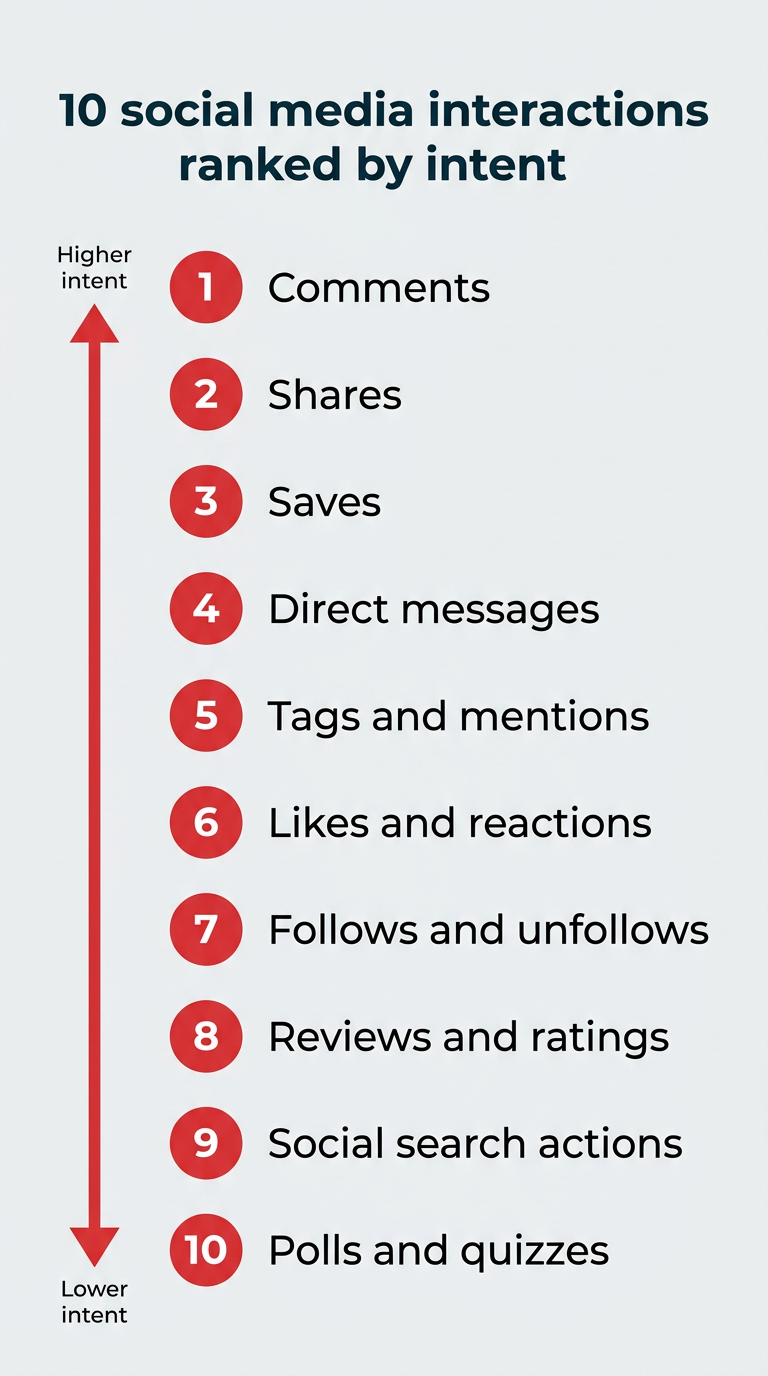
Here are the 10 most common types of social media interactions, roughly ordered from highest to lowest intent:
- Comments and conversations
- Shares
- Saves
- Direct messages
- Tags and mentions
- Likes and reactions
- Follows and unfollows
- Reviews and ratings
- Social search clicks and actions
- Polls, quizzes, and interactive content
1. Comments and conversations
Comments are when users reply directly to your posts, whether that’s with text, emojis, or by tagging other accounts. They’re also the interaction most likely to turn into a real conversation.
Think of comments as soft leads. Someone stopped scrolling, paid attention to your content, and took the time to respond. That’s intent.
Comment threads also carry weight in algorithm prioritization. When a post keeps generating replies, platforms read that as a signal the content is worth showing to more people. Your own replies count toward that activity.
But if you’re ghosting your own comment section, you’re missing out on opportunities to move potential customers closer to decision. That’s why responding back matters.

Source: Laneige U.S.
How to respond: Whether your followers are asking questions, dropping emojis, or expressing their excitement, it’s important to respond promptly. It helps your audience feel acknowledged, giving them more reason to engage again in the future.
For teams managing multiple social channels, keeping up with comments can get overwhelming. Having a central place to monitor and respond to followers, without opening multiple apps, is key for staying on top of everything.
That’s where a social inbox comes in. Tools like Hootsuite Social OS Inbox bring comments, DMs, and mentions into one place, so teams can stay on top of every message, no matter where it came from.
2. Shares
A share is when someone reposts your content to their own feed or sends it to another user.
Shares don’t just boost engagement. They introduce your brand to new audiences and add a layer of credibility, since the content is coming from someone your audience already knows.
They also extend reach well beyond your follower count, which makes them one of the few interactions that grows your addressable audience rather than just your metrics.
How to respond: Acknowledge the share whenever you can. For instance, if someone shares your post to their story, reply with a quick message or emoji reaction to show you saw it.
Bonus points if you reshare their posts to your branded channels when it aligns with your brand.

Source: OLIPOP
3. Saves
A save is when someone bookmarks your content to come back to later. Depending on the platform, this might look like saving a post, pinning it, or adding it to a collection.
Unlike likes, which are often quick and passive, saves are a strong signal that your content is resonating on a deeper level. Someone expects to need it again.
Content that gets saved frequently is also more likely to be prioritized by social media algorithms, helping extend its lifespan and reach on platforms like Instagram and TikTok.
How to respond: Look for patterns in the content that gets saved the most, whether it’s educational posts, how-tos, or inspirational content.
Then build more of it deliberately. Save-worthy formats tend to share a few traits: they’re reference material (checklists, templates, step-by-steps), they’re hard to absorb in one pass, or they’re something people want on hand when they’re ready to buy.
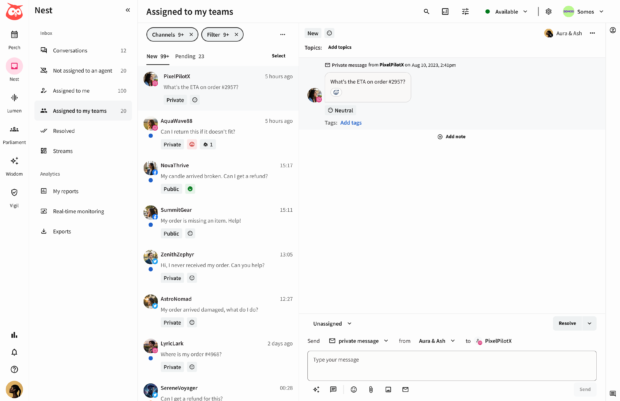
4. Direct messages
A DM (direct message) is when someone reaches out to your brand privately, usually with a question, concern, or support request. And it’s important to be ready for them.
Because so many people now prefer to reach a business through social, your inbox works as a front line for customer support rather than an afterthought.
How to respond: Stay on top of your DMs. Fast responses build trust and create positive customer experiences. On the flip side, slow or missed replies can hurt your brand reputation, especially when users are expecting quick answers.
A centralized inbox makes this a lot easier, and helps teams improve response time. For example, with Hootsuite Social OS Inbox, you can save auto-replies for common questions, allowing your team to reply quickly while keeping responses consistent.
5. Tags and mentions
A tag is when a user mentions your brand on social media. They can tag you in a post, caption, or story. It’s one of the most direct ways people interact with your brand on social.
Worth noting: plenty of people talk about brands without tagging them at all. Monitoring untagged mentions catches conversations you’d otherwise miss, including complaints that could escalate.
How to respond: The best way to respond to a tag is to engage with the post you’re tagged in. And if the content aligns with your brand, consider resharing it to your own feed. This is a great way to encourage user-generated content (UGC).
Make it a habit to review tagged posts regularly so you can source UGC and balance your content calendar with both organic and branded content.

Source: MEJURI
6. Likes and reactions
Likes are the most common form of social media interaction, and they’re best treated as a baseline signal rather than a headline success metric.
They’re a quick sign that your content is landing with your followers. Plus, the more likes you get, the more likely social media algorithms will push your content to a larger audience.
Most platforms now offer more than a single like button, too. Reactions like love, laugh, or angry give you sentiment data that a plain like count can’t.

Source: Siete Foods
How to respond: You don’t need to acknowledge every like, but you should monitor them. Tracking likes and reactions over time helps you zero-in on the types of content your audience responds to. You can then use these insights to optimize your social media strategy.
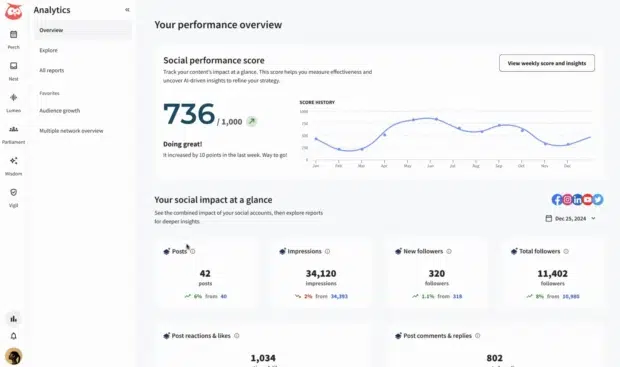
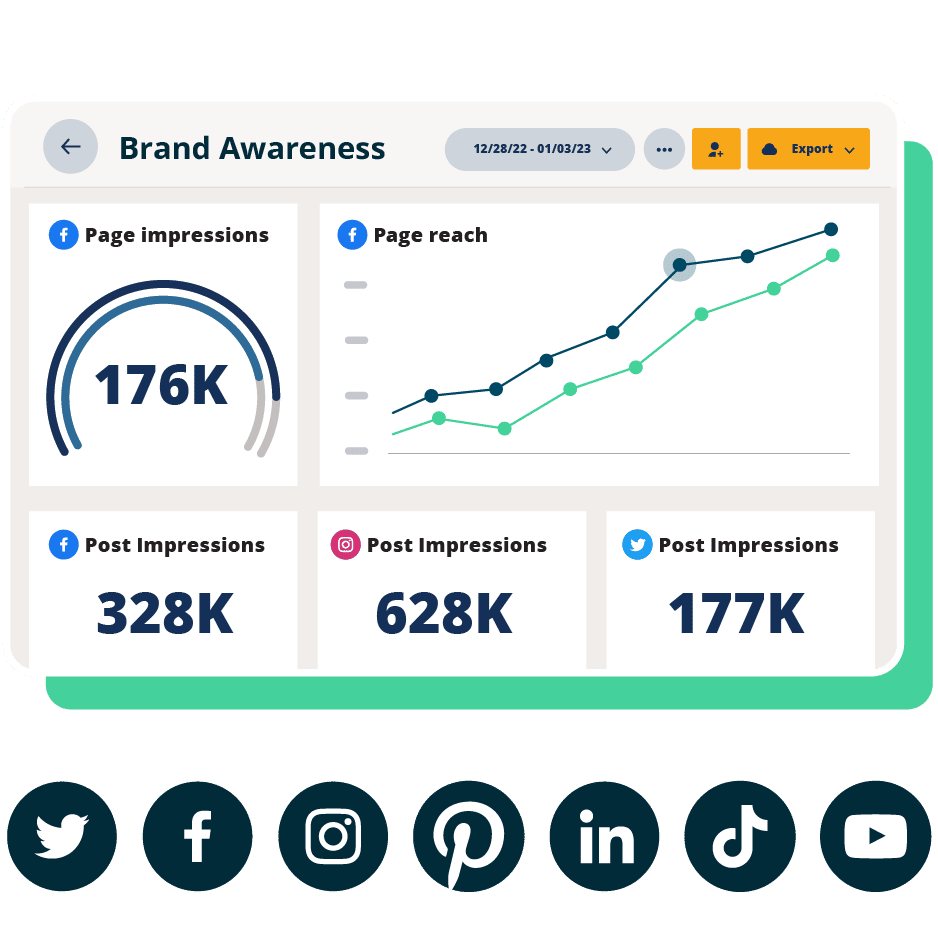
A social media management tool like Hootsuite Social OS makes it easy to track social metrics, including likes, in real time. You can look at performance by post, or step back and compare results across social networks.
Beautiful reports. Clear data. Actionable insights to help you grow faster.
Start your free trial7. Follows and unfollows
Follows are when a user chooses to follow your brand’s account or page in order to see your content in their feed.
Follows indicate that someone wants to see more of your content, a strong sign you’re reaching the right audience. Unfollows, on the other hand, tell a different story.
An unfollow is when a social media user decides not to follow your brand account anymore. While the occasional unfollow is normal, a sudden drop in followers can indicate that something in your social media content or strategy is missing the mark.
Profile visits are worth watching alongside both. A visit is the step right before a follow, so if visits are climbing but follows aren’t, the gap is usually your bio, pinned content, or profile imagery.
How to respond: Keep an eye on follower trends over time. If you notice a spike in unfollows or a slowdown in growth, review your recent content and interactions. Even small changes in tone, frequency, or direction can impact audience retention.
Pro tip: Not sure how often to post on your social media channels? We ran the numbers to find the optimal posting frequency for each social media platform.
8. Reviews and ratings
Reviews are everywhere, even on social media.
For example, people can write recommendations on Facebook, leave a product review on Instagram or TikTok Shop — which generated over $500 million during BFCM 2025 — or rate your business on your Google Business Profile.
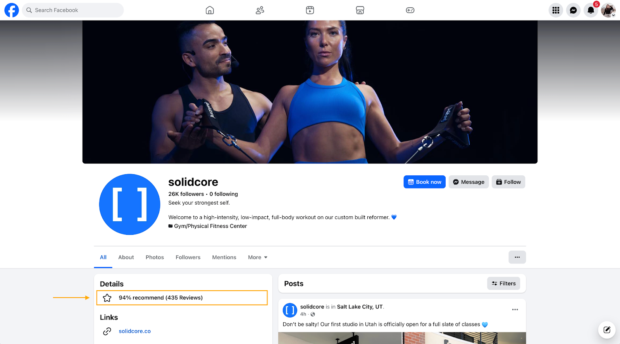
Leaving reviews is a common practice on social media.
Positive reviews help boost your brand’s social proof. When a potential customer reads another person’s feedback or experience with your brand, they’re more likely to imagine themselves making the same purchase.

Source: solidcore
Negative reviews can have the opposite effect. It’s important to stay on top of these, and respond when necessary.
How to respond: Monitor your social reviews and have a few responses prepared for positive and negative scenarios.
Remember that customer reviews, and your responses to them, are public. The way you handle feedback reflects on your brand reputation, so always remain professional.
9. Social search clicks and actions
A growing share of discovery now starts inside social apps rather than a search engine. People type a question into TikTok, Instagram, or YouTube and act on what they find.
Those actions are interactions too. Social search behaviour shows up as profile visits, link taps, product page views, and follows that arrive from search results rather than the feed.
The signal is valuable because search traffic tends to carry higher intent. Someone who found you by typing a query already knows what they want.
How to respond: Make your content easier to surface. Write search-friendly captions that use the words your audience actually searches, add alt text to images, use a small set of specific hashtags, and say your keyword out loud in video content so it lands in auto-captions.
Then watch which search-driven posts pull profile visits and link clicks, and treat those topics as a content roadmap.
10. Polls, quizzes, and interactive content
Interactive formats are interactions by design. Instagram Stories polls and sliders, LinkedIn polls, quiz stickers, and live stream comments all invite a response with almost no effort from the user.
That low barrier is the point. People who won’t write a comment will happily tap a poll option, and platforms still read that tap as participation.
How to respond: Use the results, not just the numbers. A poll that reveals which product feature people care about is audience research you can feed into your next campaign or content series.
Share what you learned back with your audience too. Posting the results of a poll gives people a reason to check in again and often triggers a second round of comments.
How to get more social media interactions in 2026
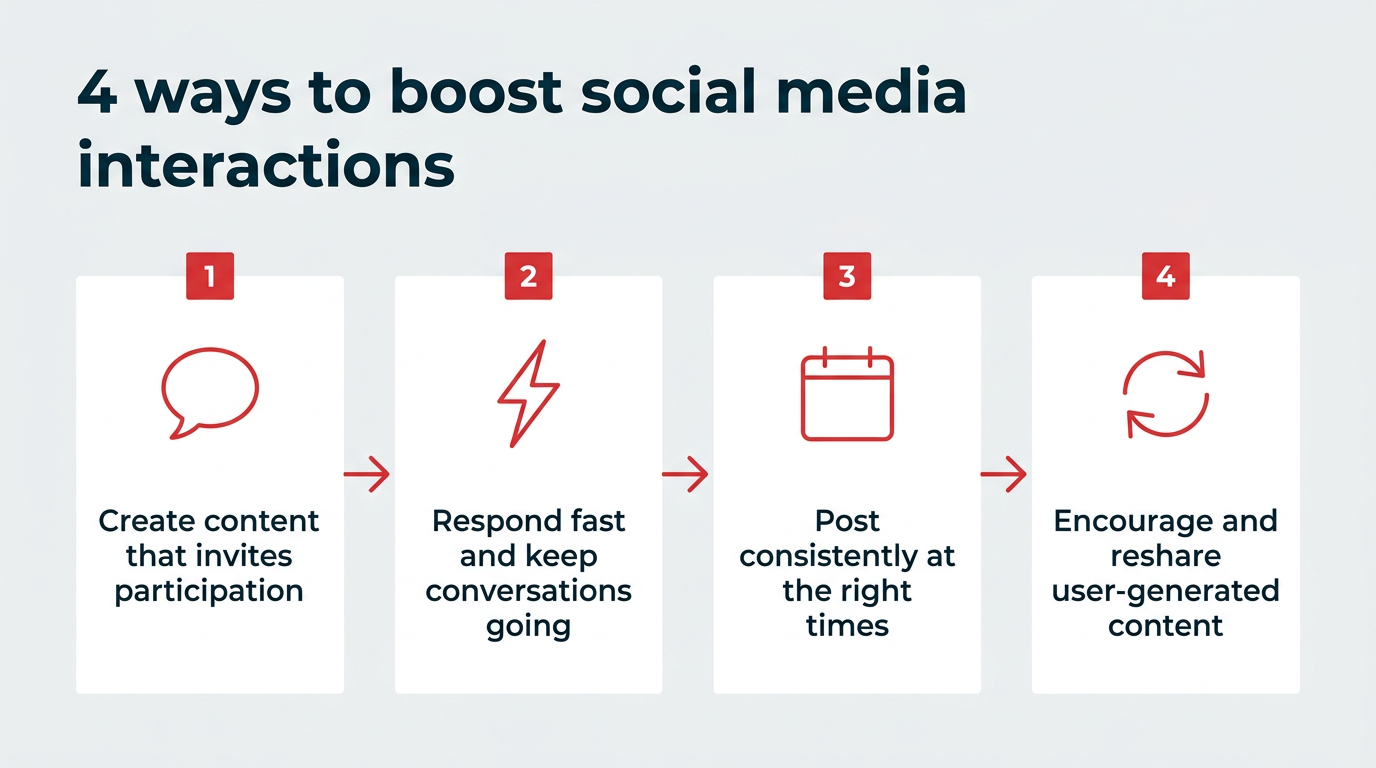
Getting more interactions comes down to being responsive, showing up consistently, and prioritizing content that invites participation. Here’s the short version:
- Create content that invites participation
- Respond fast and keep conversations going
- Post consistently at the right times
- Encourage and reshare user-generated content
Create content that invites participation
The easiest way to get a response is to make responding easy. Polls, Q&As, and quizzes let people interact with a single tap, and opinion-based or slightly polarizing questions consistently outperform generic ones.
Format matters as much as the prompt. Research shows that visual content drives the most social media engagement, so if you’ve never posted a Reel on Instagram or a video on LinkedIn, now’s a good time to start.
Not every post will land, and that’s okay. Try different formats and tones to see what works. Over time, you’ll start to spot patterns in what drives the most engagement.
Respond fast and keep conversations going
The math is simple: engagement builds engagement. When you reply to comments, it keeps the conversation going and encourages users to participate again in the future.
Speed is the part most teams underestimate. Replies that land in the first hour or two tend to pull more follow-on activity, because the post is still being distributed while the thread is growing.
Saved replies and AI-powered chatbots for common questions help teams keep pace without sacrificing quality. Set a rough response target by channel, since expectations in a DM inbox are usually tighter than in a comment thread.
Post consistently at the right times
Posting when your target audience is most active can increase early engagement, and early engagement is what tells the algorithm to keep going.
Consistency matters more than raw frequency. Three solid posts a week you can sustain will beat a burst of daily posting followed by two quiet weeks.
Tools like Hootsuite Social OS offer personalized best time to post recommendations, so you’re never guessing when to hit publish.
Encourage and reshare user-generated content
User-generated content is one of the few tactics that generates interactions twice: once from the person who made it, and again from their audience when you reshare it.
Ask for it directly. A prompt in a caption, a branded hashtag, or a simple “tag us in your setup” gives people permission to post about you.
When you reshare, credit the creator clearly and reply to them. Brands like Mejuri and OLIPOP build steady streams of tagged content this way, largely because resharing is visibly rewarded.
How to measure social media interaction
Measuring social media interaction means tracking both how many interactions you get and what kind they are. Volume alone can be misleading, since a thousand likes and a hundred saves tell you very different things about intent.
Start with your platform’s native analytics for post-level data, then use a management tool to compare across channels and spot trends over time.
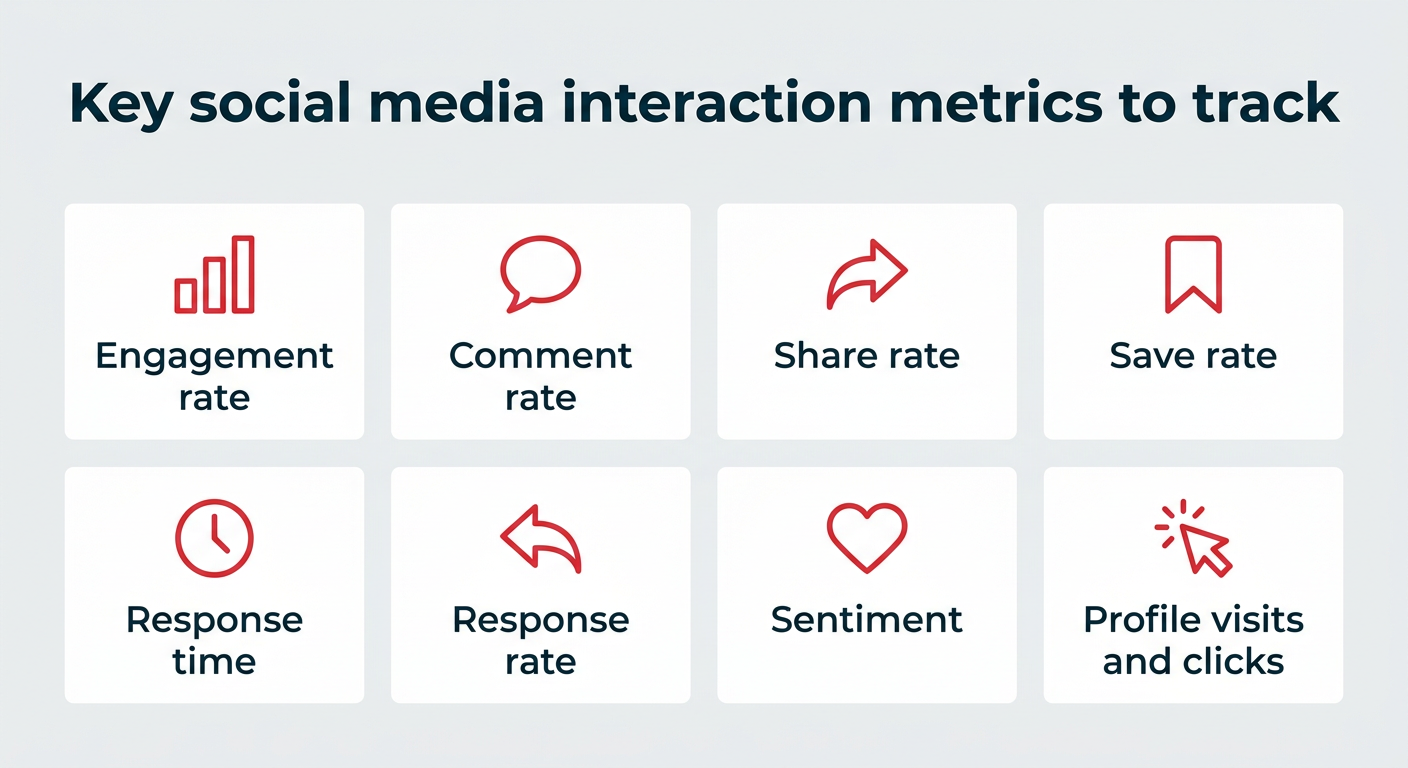
Key interaction metrics to track
| Metric | What it measures | Why it matters |
|---|---|---|
| Engagement rate | Total interactions divided by reach or followers | Your best single view of whether content is landing |
| Comment rate | Comments per post relative to reach | Signals conversation and soft purchase intent |
| Share rate | Shares per post relative to reach | Shows content is spreading beyond your followers |
| Save rate | Saves per post relative to reach | Indicates lasting value and future intent |
| Response time | Average time to reply to comments and DMs | Directly tied to customer satisfaction |
| Response rate | Share of inbound messages you actually answer | Reveals coverage gaps in your service workflow |
| Sentiment | Whether mentions skew positive, neutral, or negative | Adds meaning to raw interaction volume |
| Profile visits and link clicks | Actions taken after seeing your content | Connects interactions to downstream business results |
Track these together, not in isolation. A post with modest likes but a high save rate and strong click-through is usually doing more work than the one that spiked in likes and went nowhere.
How Hootsuite helps teams track and respond to interactions
Managing interactions across five or six platforms in separate tabs is where most teams lose time. A social operating system pulls that work into one place.
Here’s how the pieces fit together in Hootsuite Social OS:
- Unified inbox: Comments, DMs, and mentions from every connected network land in one queue, with auto-routing and saved replies to keep response times down.
- Analytics: Compare interaction metrics by post and by network, and export reports for stakeholders.
- Listening and sentiment: Catch mentions of your brand even when nobody tags you, and see whether the conversation is trending positive or negative.
- Best time to post: Personalized scheduling recommendations based on when your audience is actually active.
FAQ: Social media interaction
What is social media interaction and why is it important for brands?
What is the difference between social media interaction and engagement?
What are examples of social media interactions?
How do businesses improve social media interaction and engagement?
What types of social media interactions matter most for performance?
How do social media interactions affect the algorithm?
How do brands measure social media interaction across platforms?
What tools help manage social media interactions at scale?
How quickly should brands respond to social media interactions?
What strategies increase meaningful social media interaction with audiences?
Save time managing your social media marketing strategy with Hootsuite. Publish and schedule posts, find relevant conversions, measure results, and more â all from one dashboard. Try it free today.
The post 10 types of social media interactions to master in 2026 appeared first on Social Media Marketing & Management Dashboard.
* This article was originally published here To read more articles like this visit us at yourdigitalmarketingbootcamp.blogspot.com