How to measure and improve social media ROI in 2026
Key takeaways
- Social media ROI measures the value your business gets back from social media compared to what you invest in time, money, and resources.
- The standard social media ROI formula is ((Value generated – Costs) / Costs) x 100, but non-monetary value like brand awareness and sentiment also counts.
- Common challenges like multi-touch attribution, delayed conversions, and data silos make social media ROI harder to measure than other channels.
- Tools like Hootsuite help enterprise teams unify social data across platforms, connect social activity to business outcomes, and report ROI to stakeholders.
What is social media ROI?
Social media ROI is the value your business gets back from social media marketing and advertising. It compares what you put into social (costs, time, effort) versus what you get out.
Social ROI can be both monetary and non-monetary:
- Monetary value: Anything that directly affects revenue or pipeline (e.g., sales and conversions)
- Non-monetary value: Anything that helps your business, even if it doesn’t lead to revenue right away (e.g., follower growth or customer satisfaction)
The classic ROI formula is simple: ((value generated – costs) / costs) x 100. But social media ROI has evolved beyond simple revenue attribution.
To capture the full picture, you’ll also want to assign estimated values to non-monetary outcomes like brand awareness, sentiment, and engagement, then fold those into the same formula.
Measuring social ROI can help teams make smarter decisions and defend their budgets. Still, it’s easier said than done.
We found that social media ROI remains a big concern for marketers, with 68% reporting they worry about proving ROI from their social efforts.

This chart shows that 68% of marketers worry about proving social media ROI to stakeholders.
The good news? Social is delivering results.
According to Statista’s social commerce market data, social commerce is expected to generate $908.5 billion in 2026, up 10.7% YOY. By 2028, purchases made through social media are expected to surpass the $1 trillion mark.
Why does social media ROI matter?
With nearly 5.75 billion users worldwide in 2026, social media ROI matters because it shows how your social efforts actually support revenue, growth, and real business outcomes.
For enterprise teams, that proof is what keeps social investment safe when budgets come under scrutiny.
Tracking social ROI helps you:
- Determine where your time and money is best spent.
- Know what works and what doesn’t, based on the metrics that really matter to your business.
- Adapt to trends, audience shifts, and market conditions quicker.
- Make a stronger case for investment when it’s time to ask for more budget or headcount.
- Align social with other teams, from sales to product, by connecting social activity to pipeline and shared goals.
- Defend your budget during periods of economic uncertainty, when every line of marketing spend faces tougher questions.
The case for social is strong. Data shows that 46% of marketers believe that using social media improves sales, on top of the traffic, exposure, and lead gen benefits that indirectly boost the bottom line.
If you want to scale your social strategy or protect your budget, you need proof. Learn how to effectively communicate your social media strategy to executives with this guide on social media strategy for executives.
Why is social media ROI so hard to measure?
Social media ROI is hard to measure because social rarely gets clean, last-click credit for the value it creates. Before you dive into the how-to, it helps to understand the common roadblocks so you can plan around them.
What is multi-touch attribution across channels?
Social rarely acts alone. A customer might see your Instagram post, click an email a week later, then convert through a paid search ad. With single-touch models, social often gets overlooked. Multi-touch attribution and assisted conversion models give social fair credit for its role across the customer journey.
How do delayed conversions and long sales cycles affect ROI measurement?
Social influence often shows up weeks or months later, which is especially true for B2B and enterprise buyers. A LinkedIn post might plant the seed for a deal that closes a quarter later. If you only measure same-day results, you’ll undercount social’s true contribution.
How do you quantify non-monetary value?
Brand awareness, sentiment, and share of voice are real forms of value, but they’re hard to put a dollar figure on. To bridge that gap, many teams use proxies like customer lifetime value (CLV) or an estimated value per engagement, lead, or click.
How do data silos across platforms affect ROI tracking?
Each platform has its own analytics dashboard, which makes piecing together a complete picture manual and error-prone. Without a unified tool, you spend more time gathering data than acting on it, a challenge Nielsen’s 2025 Marketing Report identifies as one of the top barriers to calculating ROI. This is exactly where a centralized platform earns its keep, as we’ll cover later.
How do you calculate social media ROI?
Social media ROI is calculated by comparing the value generated from social media to the total cost of your social media investment. If you’re wondering how to measure social media ROI, the formula below is your starting point.
Here’s a simple formula to calculate social media ROI:
Social media ROI = ((Value generated from social media – Costs of social media investment) / Costs) * 100
To use this formula, you need two things:
- The value generated from your social media efforts
- The cost of your social media investment (both monetary and non-monetary)
Below, we’ll walk you through how to find your social media value, total your costs, and calculate social ROI with confidence.
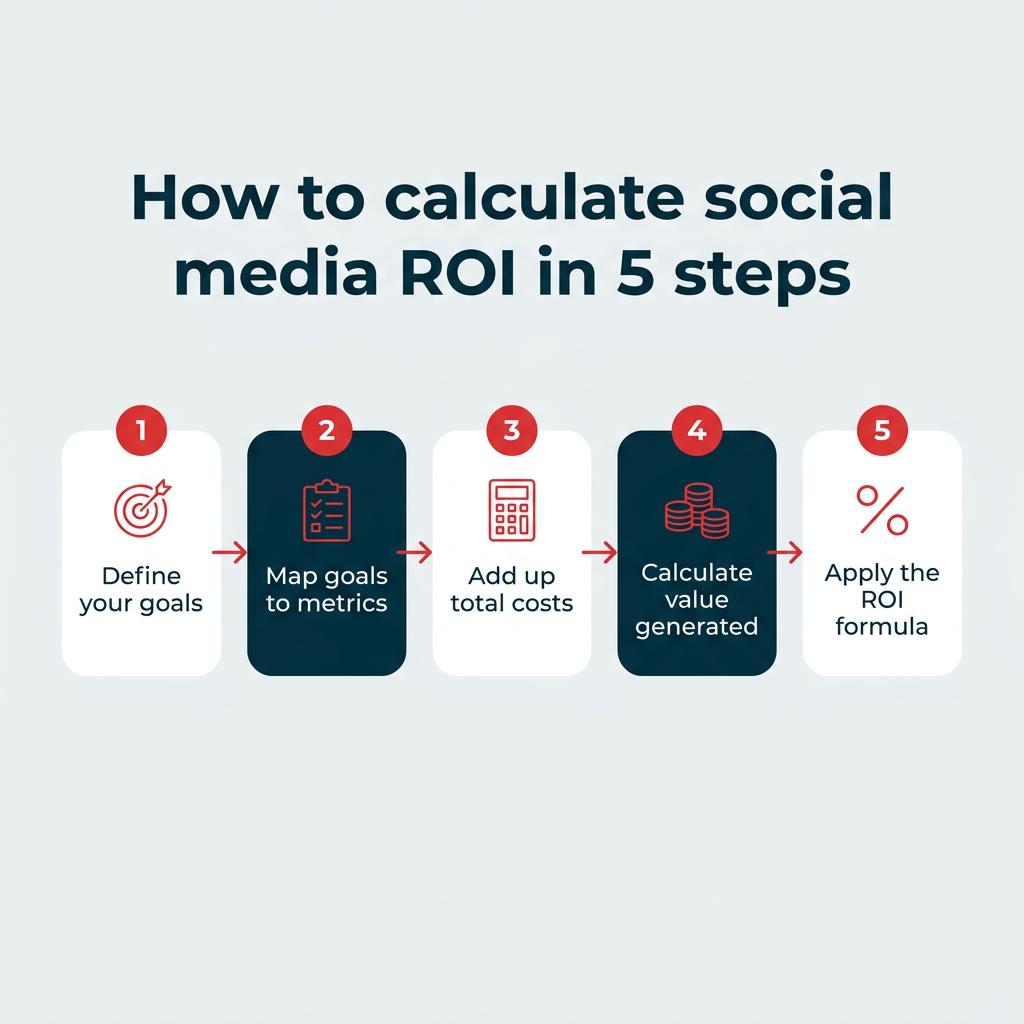
Here’s how to calculate your social media ROI in five steps:
- Define your social media goals
- Map goals to the right metrics
- Add up your total social media costs
- Calculate the value generated
- Apply the ROI formula
1. Define your social media goals
Start by getting crystal clear on what social media should do for your business. ROI looks very different depending on whether you’re focused on sales, leads, awareness, or customer experience.
Big-picture goals matter, but they’re often too broad to measure on their own. That’s why it’s helpful to set campaign-specific goals alongside higher-level objectives.
For example, campaign-specific goals might include:
- Content downloads
- Email sign-ups
- Trials
Keep in mind that goals aren’t set in stone. As Eileen Kwok, former Social & Influencer Marketing Strategist at Hootsuite, points out, “The goals you have set for at the start of the year, could have already changed. Depending on the shifts your organization is making, or the changing social landscape, make sure you are revisiting your goals every quarter to see if any updates need to be made.”
Evaluating your performance at the campaign level makes it easier to see what’s working (and what needs a rethink) over a set period of time.
2. Map goals to the right metrics
Once your goals are locked in, choose the social media metrics that help you show progress toward them.
Different goals require different metrics. For example:
- Lead generation goals = form fills, sign-ups, or downloads
- Brand awareness goals = reach, impressions, brand mentions, or sentiment
- Engagement goals = comments, shares, saves, or click-through rates
- Retention and loyalty goals = repeat engagement, customer sentiment, or community growth
The takeaway: not every metric matters for every goal, so focus on the ones that show meaningful movement.
3. Add up your total social media costs
Next, add up the full cost of your social media investment over a set period of time. This includes all the time, money, and resources that go into your social media activities (or a specific campaign).
Common social media costs include:
- Ad spend
- Influencer fees
- Agency or freelancer fees
- Software and tool subscriptions
- Employee salaries
- Content production (photography, video, design)
- Training and professional development
- Time spent planning, publishing, and reporting
You’ll want to get really granular here. If it takes time or money, it belongs in your total.
4. Calculate the value generated
At this step, calculate the total value generated by your social media efforts. This value can be monetary or non-monetary.
Monetary value includes:
- Sales or revenue attributed to social media
- Leads or conversions
- Improvements in conversion rate, cost per lead (CPL), or cost per acquisition (CPA)
Non-monetary value includes:
- Brand awareness and reach
- Engagement
- Follower growth
- Customer sentiment or satisfaction
To fold non-monetary outcomes into the formula, you’ll need to assign them a dollar value. A practical approach is to use customer lifetime value (CLV) for new followers, or an estimated value per lead, click, or engagement based on your historical conversion data. It won’t be perfect, but it gives leadership a tangible number to work with.
Pro tip  : To assign value to non-sales-y outcomes, use indicators such as customer lifetime value (CLV) or estimated values per lead, click, or engagement.
5. Apply the ROI formula
Now it’s time to crunch the numbers using the social media ROI formula above.
The result of the formula (a.k.a. your ROI) is usually expressed as a percentage.
If your ROI is above zero, your social media marketing efforts are paying off. If it’s below zero, you’re spending more than you’re getting back, which is your cue to adjust the strategy (see our improvement tips below).
What metrics should you track for social media ROI?
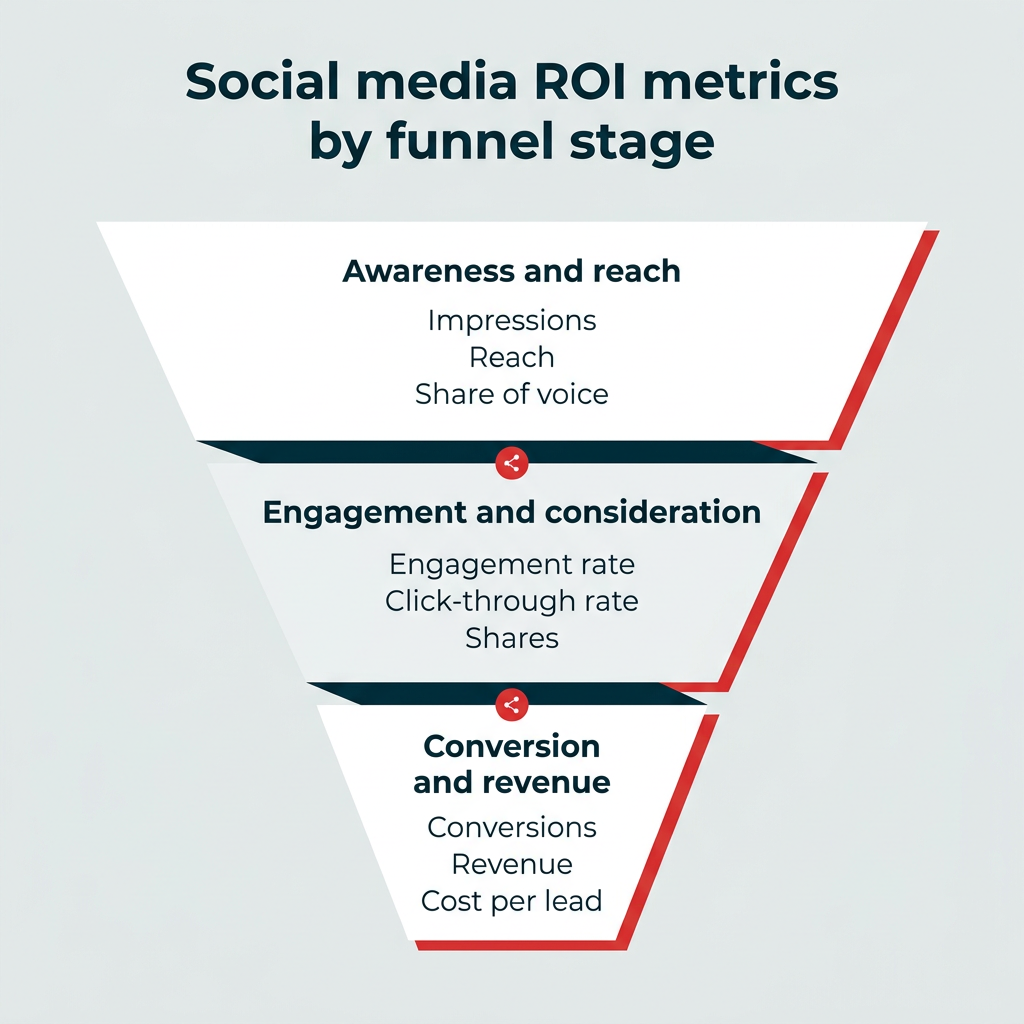
The best social media ROI metrics are the ones tied directly to your goals and to real business outcomes. Rather than tracking everything, organize your metrics by what stage of the funnel they support. The table below maps common goals to the metrics that prove progress.
Goal category | Metrics to track | What it tells you |
|---|---|---|
Awareness and reach | Impressions, reach, brand mentions, share of voice, follower growth rate | How many people are seeing and talking about your brand |
Engagement and consideration | Engagement rate, click-through rate, saves, shares, comments, video views | How much your audience interacts with and values your content |
Conversion and revenue | Conversions, revenue attributed to social, cost per lead, cost per acquisition, ROAS | How effectively social drives leads and sales |
What metrics should you track for awareness and reach?
Awareness metrics show how far your brand is spreading. Track impressions, reach, brand mentions, share of voice, and follower growth rate to gauge whether more of the right people are discovering you. These sit at the top of the funnel and often translate to value down the line.
What metrics should you track for engagement and consideration?
Engagement metrics reveal whether your content actually resonates. Watch engagement rate, click-through rate, saves, shares, comments, and video views. Strong engagement signals that your audience finds your content worth their time, which is a leading indicator of future conversions.
What metrics should you track for conversion and revenue?
Conversion metrics are where ROI gets concrete. Measure conversions, revenue attributed to social, cost per lead, cost per acquisition, and return on ad spend (ROAS). These connect your social activity straight to the bottom line and are the numbers executives care about most.
What are some social media ROI examples?
Here are a few examples of how this social media ROI calculation might work IRL.
How does an e-commerce business calculate social media ROI?
An e-commerce business wants to measure the ROI of its latest social media marketing campaign aimed at increasing sales. Here’s how they could do it:
- Value generated: $50,000 in sales from social media referrals
- Costs: $10,000 on TikTok and Facebook ads, $5,000 on content creation, $3,000 on software subscriptions
- ROI calculation: ((50,000 – 18,000) / 18,000) * 100 = 178%
This means the campaign generated 178% more value than the resources invested.
How does a B2B company calculate social media ROI?
A B2B company focuses on lead generation through LinkedIn. They want to calculate the ROI of their efforts:
- Value generated: 100 qualified leads, each valued at $200, totaling $20,000
- Costs: $2,000 ad spend on LinkedIn, $1,500 on content creation, $500 on analytics tools
- ROI calculation: ((20,000 – 4,000) / 4,000) * 100 = 400%
This indicates a 400% return on their social media investment.
How do you calculate ROI for brand awareness campaigns?
A brand runs a quarter-long awareness campaign where the goal isn’t direct sales. They estimate value using a CLV proxy:
- Value generated: 2,000 new followers, with an estimated value of $15 each based on CLV, totaling $30,000
- Costs: $8,000 on content and paid promotion, $2,000 on tools
- ROI calculation: ((30,000 – 10,000) / 10,000) * 100 = 200%
This shows how to put a number on ROI even when the goal isn’t immediate revenue.
What is a good social media ROI?
A good social media ROI depends on your industry, goals, and whether you’re measuring paid or organic efforts. There’s no universal “good” number, but any positive ROI means your social investment is generating more value than it costs.
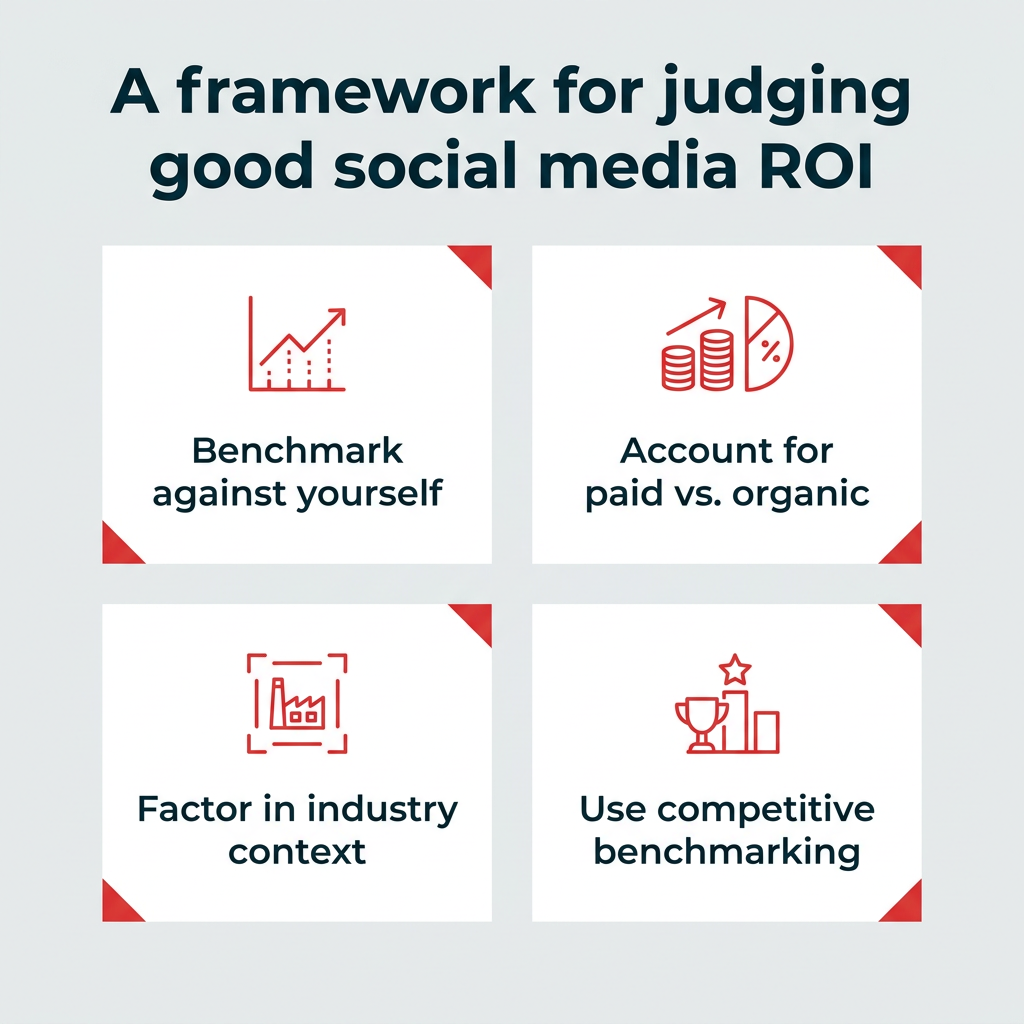
Rather than chasing a single benchmark, here’s a more useful framework:
- Benchmark against yourself: Your most reliable yardstick is your own past performance. If this quarter’s ROI beats last quarter’s, you’re moving in the right direction.
- Account for paid vs. organic: Paid ROI is easier to measure and often shows clearer returns, while organic ROI relies more on proxy metrics and compounds over time.
- Factor in industry context: A high-margin e-commerce brand and a long-cycle B2B company will see very different ROI ranges, so compare like for like.
- Use competitive benchmarking: Competitive benchmarking against similar brands in your niche tells you whether your returns are strong relative to peers facing the same conditions.
The bottom line: a positive, improving ROI that outpaces your industry peers is a strong result, regardless of the exact percentage.
How can you improve your social media ROI?
Improving your social media ROI comes down to testing what works, tracking results, and refining your strategy over time.
Here’s how to get started:
How can A/B experiments improve your ROI?
Social media is a constantly changing landscape where testing and tweaking is key to getting the most out of your efforts. And experimentation is a must.
As Kwok shares, “Social is a place where we are continuously testing new content, features, and learning what’s working/not working.” And Kwok is right.
One way to do this is by running A/B tests on social media content. Experiment with different topics, formats, and posting times to optimize your content. You can also run experiments through organic social accounts and paid social media ads.
For example, we ran an experiment to test whether Instagram carousels perform better than Reels. After three weeks, we found carousels earned better engagement and reach!
Check out all our social media experiments here.
There are many factors you can test, including:
- Visual assets
- Post format/ad format
- Post copy
- Call to action
- Link placement
- Hashtags
- Target audience
Testing helps you learn what types of content actually resonate with your followers. Based on those insights, you can scale up that content or ad and increase your social media advertising ROI.
How can analyzing competitor strategies improve your ROI?
It’s one of the most tried and true rules in social media: check out what your competitors are doing.
Social posts are public, so you can see who liked what and how much on any public-facing profile. But you can take it a step further with tools like Hootsuite Analytics. It lets you track competitor results across channels and see industry benchmarking data that shows how you stack up in your niche.

Hootsuite Analytics lets you track competitor performance to improve your social media ROI strategy.
Beautiful reports. Clear data. Actionable insights to help you grow faster.
Start your free trialHow do UTM parameters help track conversions?
One of the easiest ways to track social media ROI is with Urchin Tracking Module (UTM) parameters.
UTM parameters are tags you add to the ends of your URLs that let you track exactly how much traffic a specific URL (like a landing page) gets.

This example shows how UTM parameters track specific social media posts to measure ROI.
So, if you have a URL on your LinkedIn post that directs users to your online store, you’ll be able to see exactly how many people went to your store from that post, and who actually bought from you.
Now that’s what we call measuring social media ROI.

Using UTM links helps connect social media activity directly to conversions and ROI.
How can social commerce improve your ROI?
Social commerce is one of the fastest-growing ways social drives direct revenue. With social commerce expected to generate $908.5 billion in 2026, shoppable posts and in-app checkout turn engagement into sales without ever leaving the platform.
To measure social commerce ROI, track in-app purchases, product tag clicks, and checkout completions directly within each platform’s commerce tools. Because the path from discovery to purchase happens in one place, shoppable ads offer closed-loop measurement that makes attribution cleaner here than almost anywhere else in social.
How do high-performing content formats improve ROI?
Not every format delivers equal ROI, so let your analytics guide where you spend. Use performance data to identify which formats (video, carousels, or static posts) drive the best results on each platform, then double down on the winners.
Our own carousel-versus-Reels experiment is a good reminder that the highest-effort format isn’t always the highest-performing one.
How does refining audience targeting improve ROI?
Tighter targeting almost always means better returns on paid social. Use retargeting to re-engage people who already know your brand, build lookalike audiences from your best customers, and lean on social data to narrow your targeting for stronger ROAS. The more precise your audience, the less budget you waste on people who’ll never convert.
How do you track social media ROI with the right tools?
The best way to track your social media ROI today is to use the right mix of tools. Most teams pull from a few categories: native platform analytics for channel-level data, web analytics like Google Analytics for conversions, CRM tools to tie social to revenue, and a social media analytics platform to bring it all together.
The challenge with stitching these together manually is data silos. That’s where a unified platform like Hootsuite Analytics comes in.
How does Hootsuite unify social media ROI tracking?
Hootsuite brings your social data into one place so you can connect activity to business outcomes without juggling a dozen dashboards.
If you want to prove your social media ROI, you’ll need to know how your content is performing across every channel. Tracking engagement metrics over time makes it easier to identify what content topics or formats connect with your audience, which helps you adapt your content marketing strategy.
With Hootsuite’s analytics tools, you can fine-tune your campaigns by examining how your content performs month after month and across different platforms. Then, get practical tips on how to expand your content’s reach and social media performance.
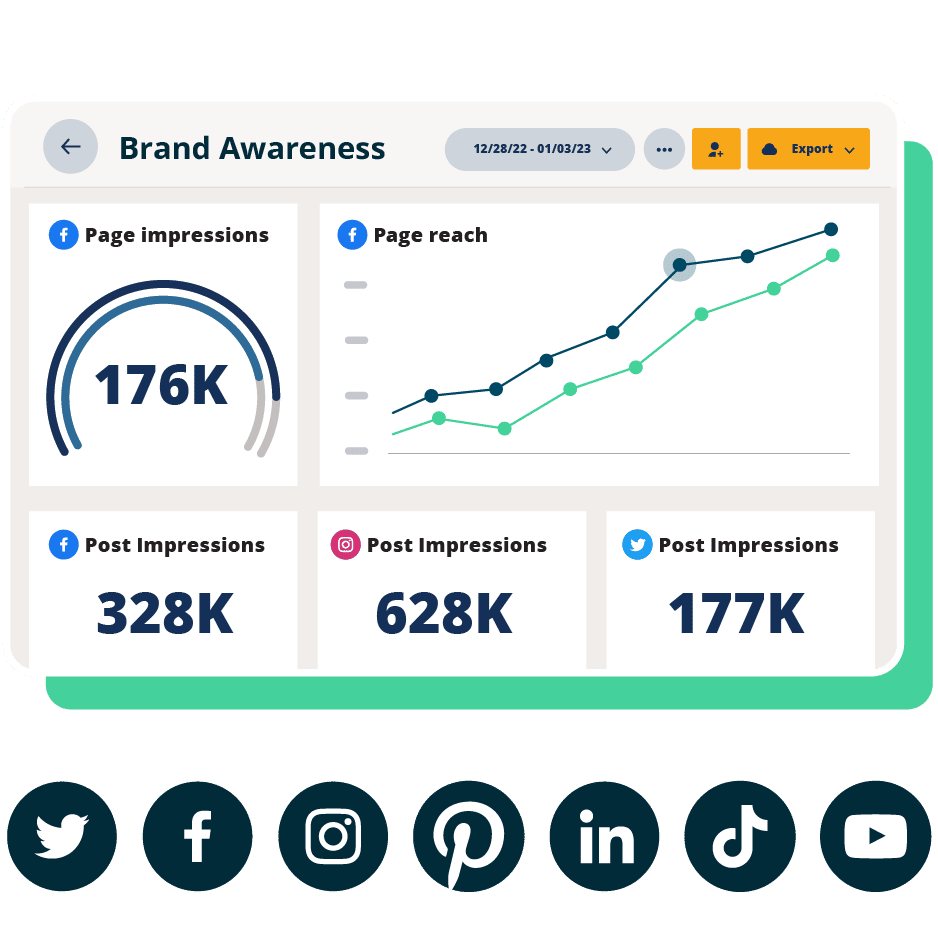
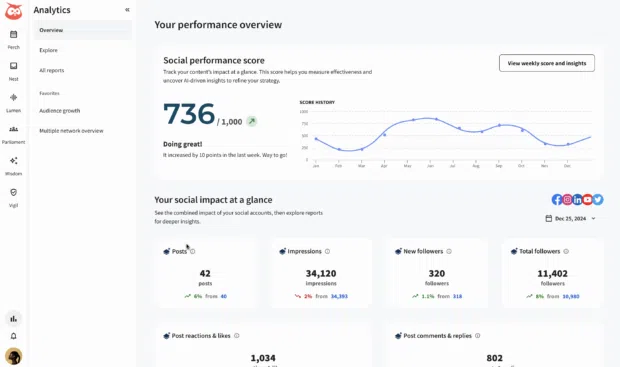
Hootsuite’s unified dashboard helps track social media ROI across all platforms in one place.
With Hootsuite’s Advanced Analytics, you can easily highlight what’s working (and what’s not) so you can zero in on your best-performing activities. Track sales, sign-ups, and conversions from specific posts and use this info to craft content that really hits the mark.
Advanced Analytics connects social media activity directly to ROI outcomes like sales and conversions.
Want to stay ahead of the competition? Hootsuite lets you keep an eye on up to 20 competitors per social network on Advanced and Enterprise plans. It shows you what’s clicking for them, like their top posts, trending hashtags, and favored content styles, so you can adjust your strategy based on what’s already proving successful.
Compare your social media ROI against competitors to identify improvement opportunities.
Plus, use Hootsuite’s social media benchmarking to see how you measure up against the industry at large. By checking metrics such as profile impressions, reach, followers, and engagement rates, you can spot areas for improvement and growth.
Industry benchmarking helps you understand if your social media ROI is competitive.
One of the best ways to sell your social media efforts to your stakeholders is through regular, in-depth reporting. Hootsuite’s reporting tool helps you create visually appealing reports that clearly show the performance of your paid and organic social media channels. Start from scratch or use templates to communicate the impact of your social campaigns.
Custom reports help communicate social media ROI to stakeholders effectively.
Social media ROI can come from anywhere, even outside of social media. Hootsuite doesn’t limit you to social metrics. By integrating with platforms like Google Analytics or Adobe Analytics, you can see how your social efforts contribute to broader business goals.
These integrations help you track essential actions like sign-ups and purchases, providing a clear view of how each social media post impacts your bottom line.
Integration with Google Analytics connects social media activity to website conversions and ROI.
Link tracking and web attribution tools can also help tie social efforts directly to business outcomes. By associating unique post IDs with each social post, you can connect web conversion data back to specific social activities. And with real-time analytics, marketers can spot trends as they emerge instead of waiting for end-of-month reports.
How should you report social media ROI to stakeholders?
To report social media ROI to stakeholders effectively, tailor your message to the audience and connect every metric back to business outcomes. A polished report is how you prove social’s value and protect your budget.
Here are a few best practices to keep your reporting sharp:
- Tailor to your audience: Executives want revenue, growth, and cost savings, while your marketing team wants tactical detail. Match the report to who’s reading it.
- Lead with business outcomes: Skip the vanity metrics. Open with how social influenced pipeline, leads, or savings.
- Show trends over time: A single snapshot rarely tells the full story. Visualize performance across quarters so stakeholders see direction, not just a moment.
- Keep it clear and concise: Use plain language and clean visuals. The faster someone grasps the takeaway, the more credible you look.
- Set a consistent cadence: Report monthly on key metrics and dive deeper quarterly so insights land before budget cycles close.
For more on speaking the language of leadership, see our guide on building a social media marketing strategy.
A quick word on goals before you report: as Kwok notes, “You don’t know what your ROI is until you’ve laid out the goals you are tracking towards.” In short, you can’t measure what you haven’t set.
FAQ: Social media ROI
How do enterprise organizations measure social media ROI?
Enterprise organizations measure social media ROI by tying social activity directly to business goals like revenue, leads, and cost savings. This typically involves centralized reporting tools like Hootsuite to track performance across teams, platforms, and regions, paired with attribution models that give social fair credit for multi-brand and multi-region campaigns.
Which social media ROI metrics show real business impact?
The social media ROI metrics that show real business impact are the ones tied to business outcomes, such as revenue influenced by social, leads generated, cost per lead, conversion rate, and customer retention. The right metrics depend on your goals, but they should always show how social supports the bigger picture.
How do leading brands connect social media ROI to revenue?
Leading brands connect social media ROI to revenue by using tracking tools, clear attribution models, and shared data across teams. By layering multi-touch attribution with CRM integration, they can see how social supports the customer journey from first touch to final conversion.
What tools help prove social media ROI across channels?
Tools that bring all your social data together help you prove social media ROI across channels. Platforms like Hootsuite let teams track performance across social networks, connect social results to business goals, and share clear reports with stakeholders. When your data lives in one place, it’s easier to see what’s working and show how social supports the bigger picture.
How should you report social media ROI to executive stakeholders?
When reporting social media ROI to executive stakeholders, focus on what matters most to the business. Keep reports clear and concise, highlight trends over time, and connect social results to revenue, growth, or cost savings whenever possible.
What is a good social media ROI percentage?
A good social media ROI percentage depends on your industry, goals, and whether you’re measuring paid or organic efforts, but any positive ROI means your social investment is generating more value than it costs. The best benchmark is your own past performance, followed by competitive benchmarking against peers in your niche.
How do you calculate social media ROI?
To calculate social media ROI, use the formula: ((Value generated from social media – Costs of social media investment) / Costs) x 100. You’ll need to total your costs, measure both the monetary and non-monetary value created, and express the result as a percentage.
Which social media platform has the highest ROI?
The social media platform with the highest ROI varies by industry and audience, but in 2026, short-form video platforms like TikTok and Instagram Reels consistently rank among the top performers for both engagement and conversion. The best approach is to test across platforms and let your own analytics show where your audience converts.
How often should you measure social media ROI?
You should measure social media ROI at least quarterly, with monthly check-ins on key metrics, to catch trends early and adjust your strategy before budget cycles close. More frequent reviews are useful during active campaigns when you can still optimize spend.
What is the difference between social media ROI for paid vs. organic?
The difference between social media ROI for paid versus organic is mainly in how easily you can measure it. Paid ROI is typically simpler to calculate because ad platforms provide direct conversion tracking, while organic ROI often requires proxy metrics like engagement value, estimated reach value, or assisted conversions.
Save time managing your social media marketing strategy with Hootsuite. Publish and schedule posts, find relevant conversions, measure results, and more â all from one dashboard. Try it free today.
The post How to measure and improve social media ROI in 2026 appeared first on Social Media Marketing & Management Dashboard.
* This article was originally published here To read more articles like this visit us at yourdigitalmarketingbootcamp.blogspot.com