How to build an enterprise social strategy in 2026
Key takeaways
- An enterprise social media strategy coordinates publishing, governance, measurement, and AI across multiple teams, brands, and regions from one unified plan.
- The biggest challenges at scale are inconsistent brand voice, slow approvals, fragmented tools, and difficulty proving ROI to leadership.
- AI-powered insights and governed workflows are now table stakes for enterprise social media management in 2026.
- The right enterprise social media platform connects listening, publishing, care, advocacy, and analytics in a single system.
What is enterprise social media?
Enterprise social media is the strategic use of social platforms by large organizations to manage brand communications, customer engagement, and business intelligence at scale. An enterprise social media strategy is the plan that ties it all together, covering how you show up on each platform, the tools you use, and the processes you put in place to stay consistent.
People sometimes confuse enterprise social media with an enterprise social network. They are not the same thing. Enterprise social media is external-facing and used for marketing and communications. An enterprise social network is an internal collaboration tool for employees. Here is how the two compare:
Dimension | Enterprise social media | Enterprise social network |
|---|---|---|
Primary audience | External (customers, prospects, public) | Internal (employees) |
Purpose | Brand marketing and communications | Employee collaboration and comms |
Example platforms | LinkedIn, Instagram, TikTok | Yammer, Viva Engage, Slack |
Key metrics | Engagement, reach, sentiment | Adoption, participation, knowledge sharing |
Hootsuite Amplify makes it easy for your employees to safely share your content with their followers, boosting your reach on social media. Book a no-pressure demo to see it in action.
How enterprise social media differs from small business social
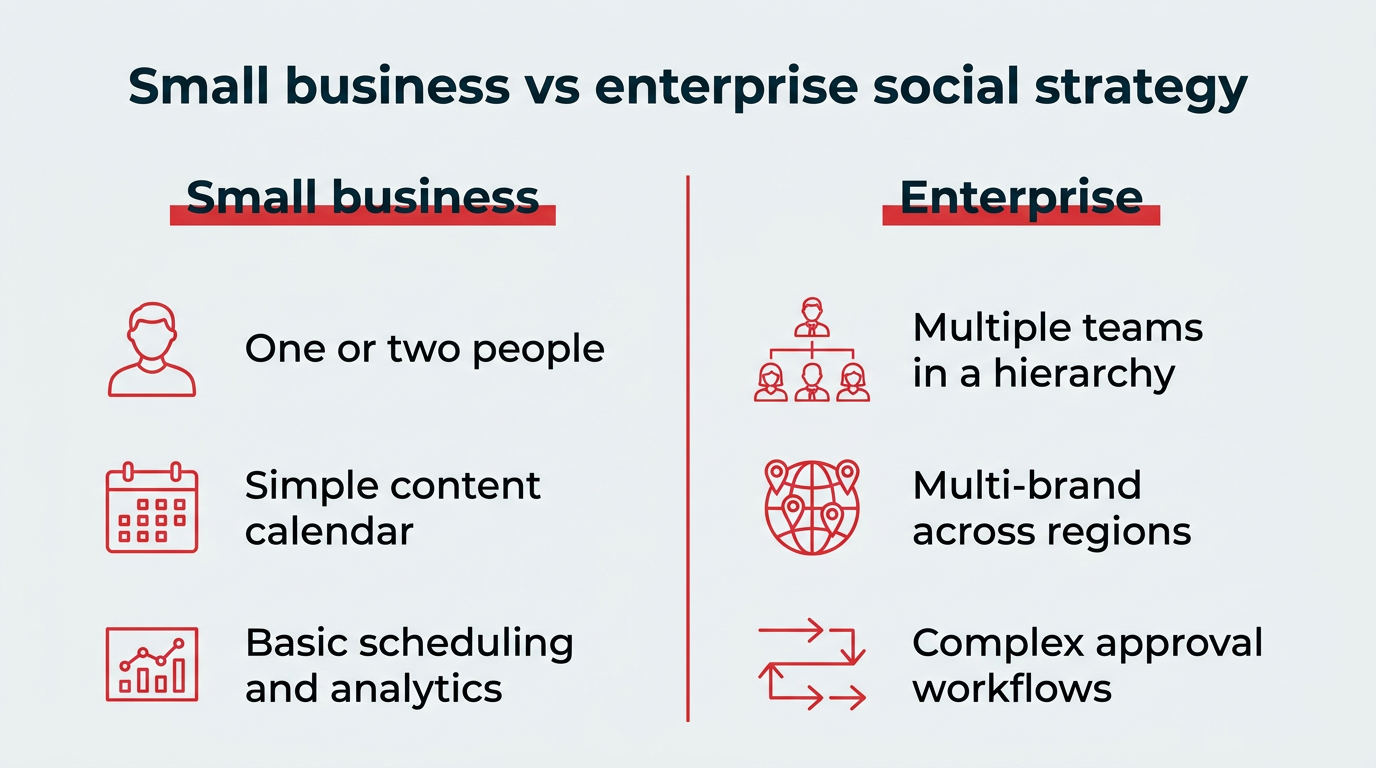
Enterprise-level social media management is large and complex. An enterprise-level strategy has more moving parts than a smaller social team’s.
Small businesses can get away with a pared-down social strategy. Often, it’s something a content creator and a social manager can manage on their own, or just one person on the marketing team handling it alongside other duties.
This might look like a simple content calendar outlining when and what to post, and a tool for analytics and scheduling.
Larger enterprise-level organizations’ social strategies may contain:
- Multiple team members in a hierarchy
- Cross-functional collaboration between other departments
- Multiple brand accounts across regions or business units
- Complex approval workflows and compliance requirements
- Larger content libraries, paid social budgets, and data streams
- Standardized social media content
- A greater need for unified messaging and brand consistency across markets
The goals aren’t just visibility and engagement for enterprise social. It’s also governance, scalability, and risk management.
“A strong enterprise social strategy comes down to three things: your audience, your brand, and your goals,” says Savannah Wiles, Staff Marketing Manager, Social & Influencer at Intuit Mailchimp.
“For the audience, remember they’re real people, not just job titles.” For your brand, Wiles recommends creating a unique and human persona.
“Brands on social are almost cosplaying as people, so duality is possible with structure around where and when you shift,” says Wiles.
“Finally, every post should provide value, hard stop. That could mean driving downloads with new POVs or data, but it may also mean being relatable to drive engagements and shares.”
Why a unified strategy matters for large organizations
A unified strategy gives your social presence focus and takes it from a visibility tool to a growth machine by aligning teams behind one voice, vision, and set of marketing goals. Without one, larger organizations get scattered, fast.
Take Nike, for example. On Instagram alone, Nike has hundreds of secondary accounts. These accounts all have different target audiences and regions.
Each account likely has its own team of managers, strategists, and content creators. Each team has their own individual goals. But those individual goals must all serve Nike’s greater business goals. And each of those secondary accounts must be in line with the Nike brand.
Then you layer in things like product-specific messaging, legal compliance, and external collaborations. Before you know it, you’re dreaming about a unified enterprise-level strategy.
Key components of an enterprise strategy
An enterprise social media strategy should outline these key components:
- Clear, measurable goals
- How to measure social success
- The structure of the internal team, and their roles and responsibilities
- Workflows and approval processes
- Brand voice, style rules, and content standards
- Tools
- Access to any employee advocacy programs
- Any secondary accounts and how they differ from and support the main account
Why do enterprises need a social media strategy in 2026?
In 2026, social media, now a $276 billion global ad market, is a core business channel for enterprise-level corporations. A defined strategy helps that channel stay consistent, compliant, and competitive. It also protects you from the coordination problems that grow with every new region, brand, and account you add.
Challenges of scale
Enterprises juggle multiple brands, regions, and audiences, often across different time zones and languages. That means coordinating approvals when half your team is asleep, navigating regulatory rules that vary by market, and untangling the tool fragmentation that builds up when each team buys its own software.
A centralized strategy ensures:
- Consistent messaging across teams
- Efficient collaboration through shared tools and workflows
- Localized content that still aligns with global goals
Protecting brand trust in complex environments
The bigger the organization, the higher the stakes. Every post represents your brand, and a single misstep can spread across platforms in hours. One poorly worded reply or an off-brand post from a regional account can turn into a reputation issue before leadership even sees it. That is why brand consistency and early detection matter so much at scale.
A strong strategy includes:
- Clear governance and approval layers
- Social listening to detect issues early
- Predefined crisis communication protocols
Leveraging social as a growth engine
Social media is a revenue driver. U.S. social commerce exceeds $100 billion in 2026, and it is an integral part of your brand’s external ecosystem. When someone wants to get to know your brand, your Instagram or LinkedIn is the first place they’ll look.
You can use social media to:
- Build thought leadership and community trust
- Understand who your audience is through audience insights and follower data
- Support sales through social selling and advocacy
- Deliver real-time customer care
- Support employee retention through advocacy programs
- Attract top talent with culture posts
How is AI reshaping enterprise social media in 2026?
AI has moved from a content-generation novelty to an operational intelligence layer that sits across enterprise social media. In 2026, it does far more than draft captions. It reads sentiment in real time, routes work to the right people, and connects insight to action across teams and regions.
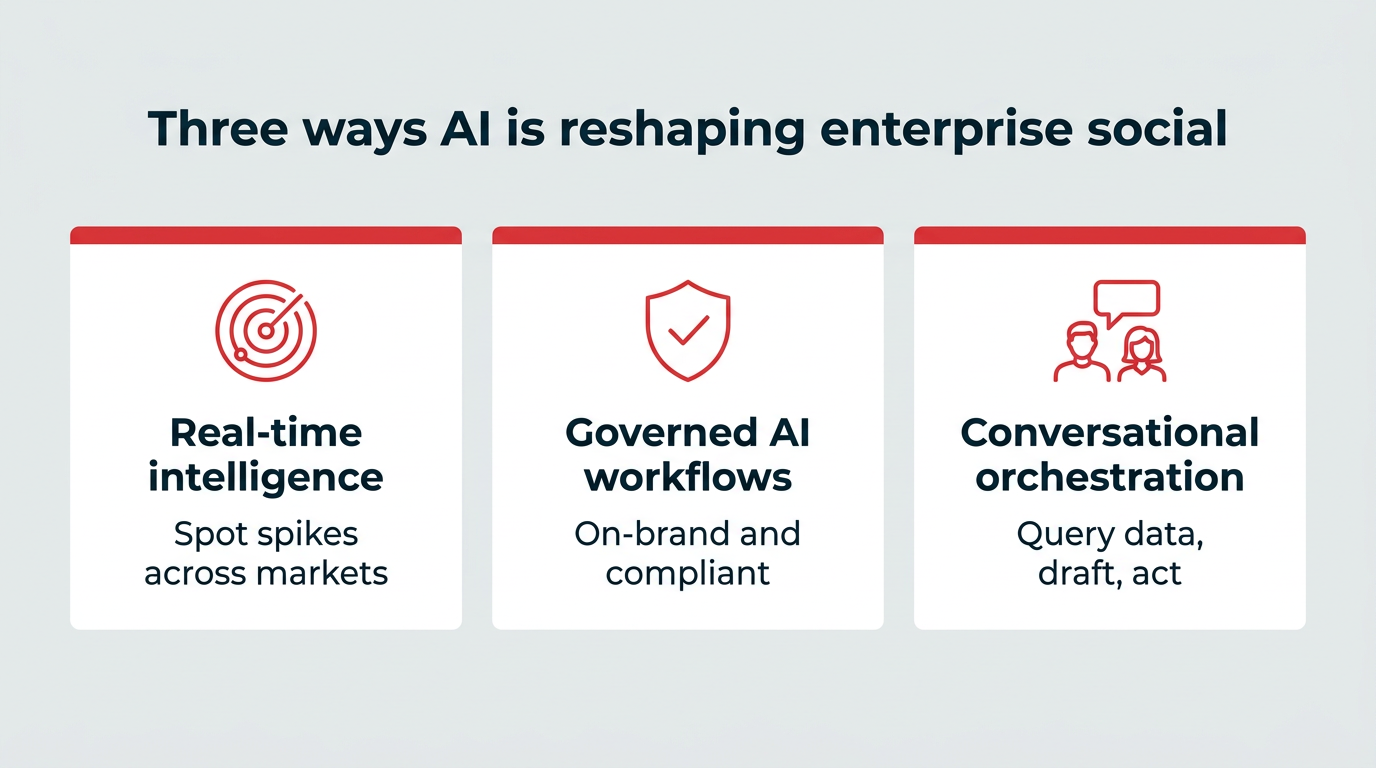
Three shifts define how AI is changing enterprise social media management:
- Real-time intelligence at scale: AI-powered listening surfaces spikes, sentiment shifts, and emerging topics across markets before a human would spot them. Lumen, the integrated insights and listening app inside Hootsuite Social OS, turns that noise into real-time intelligence your teams can act on.
- Governed AI workflows: Enterprises need AI that operates inside guardrails. Governed workflows keep outputs on-brand, compliant, and traceable, so AI supports human decision-making instead of replacing judgment.
- Conversational orchestration: Wisdom, the AI orchestration layer in Hootsuite Social OS, connects insight to action, helping teams query data, draft content, and move faster without leaving their workflow.
AI also connects to the rest of your stack. Through MCP connectors, contextual intelligence flows between your social platform and the systems your business already relies on, keeping AI outputs grounded in real data rather than guesswork.
Why governance matters more than ever with AI
Governance matters more than ever with AI because ungoverned AI is a real risk at enterprise scale. Without controls, AI can generate off-brand content, surface unverified claims, or publish something that violates regulations. In healthcare, finance, and other regulated industries, that is not a minor inconvenience. It can mean fines, legal action, and lasting reputational damage.
Vigil is the governance layer in Hootsuite Social OS. It keeps AI-assisted work inside your policies, so every output is traceable and every approval is documented. For regulated teams, that combination of speed and control is what makes AI usable at all.
What should an enterprise social media strategy include?
A solid enterprise social strategy gives every team a shared roadmap. This outlines how to show up, measure success, and scale, and increasingly it includes how AI is governed across the organization.
Strategic goals and KPIs
Define what success looks like and tie it to measurable KPIs. For example, if brand awareness is one of your goals, you’ll want to measure share of voice and audience sentiment. Social listening tools like Lumen can help.
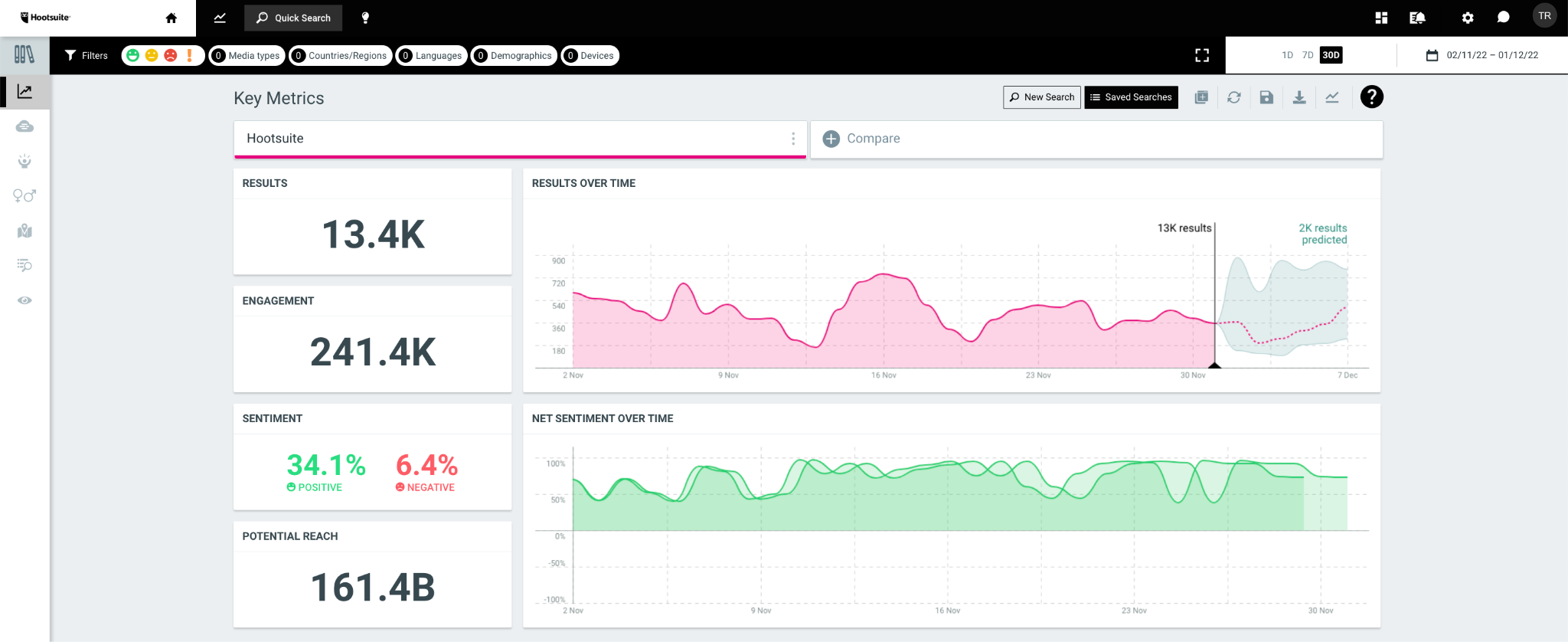
Then, you can use your data to show how social supports larger business outcomes. Did revenue spike following a social campaign? Could be due to your quality content and superb social media efforts.

Brand mentions, trending topics, and sentiment at your fingertips. Enhance your social strategy with the insights that matter.
Start your free trialRoles, responsibilities, and governance
Say who does what. Who owns which channel? Who approves what? How, exactly, should teams collaborate?
You can make this easy by using Hootsuite’s permissions to choose who has access to what.
Also, be sure to establish policies and procedures for both the average day-to-day and the occasional crisis. It’ll definitely save you time, and it can also save your bacon.
Clarity gives people the freedom to work without a ton of oversight. This increases efficiency and trust within the team.
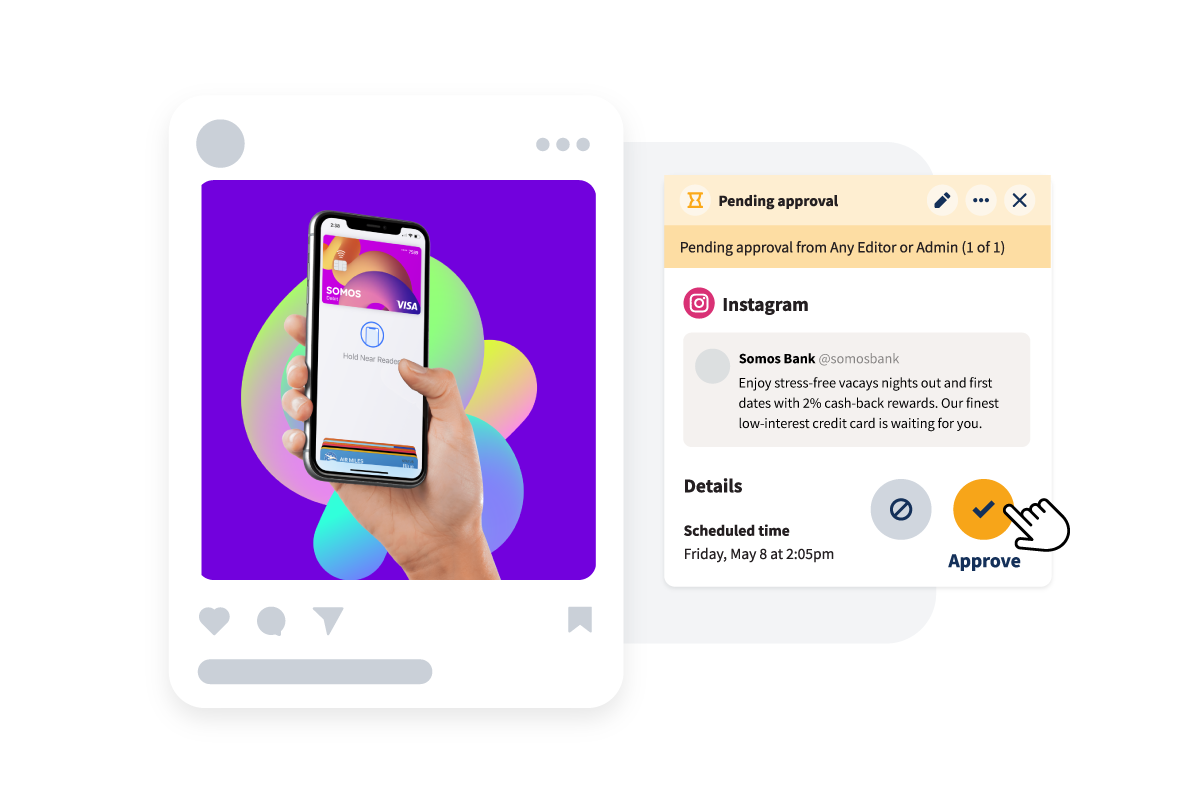
Pro tip : Hootsuite Social OS allows you to customize both workflows and approvals.
Tools and systems for execution
Enterprise teams need centralized platforms to manage publishing, approvals, and analytics at scale.
Hootsuite Social OS streamlines your creation, collaboration, and reporting. We go deeper on tool selection later in this guide.
Content and brand standards
Create clear guidelines for voice, visuals, and values. This way, every region and team speaks with one brand voice. Use shared asset libraries and templates to keep quality high and messaging consistent. You want to look like a unified social media presence across the board.
Hootsuite’s content library stores approved assets and templates in one place. So your teams can find, share, and publish on-brand content.
Compliance and regulatory policies
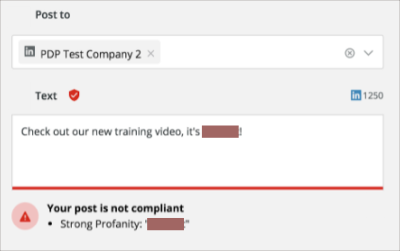
Are you an enterprise organization in a regulated industry? Then it’s essential to have compliance and governance built into your social media strategy. The alternative isn’t just a risk. Publishing content that breaks industry rules can result in significant fines, legal action, and platform bans.
Hootsuite has robust security features for enterprise organizations. Take the integration with Proofpoint. Proofpoint allows you to automate the review of social media posts for compliance. Vigil adds a governance layer on top, keeping approvals, AI outputs, and published content inside your policies and fully traceable.
A unified global strategy you can execute across local markets
Enterprise social strategies often span global markets. But what works on the West Coast of Canada won’t translate to Southeast Asia. You’ve got to be able to keep your brand globally consistent but regionally adaptive.
“When you have a strong brand identity and consumer product need, you can build a foundational strategy and approach that is 80% consistent globally,” says Wiles.
“Then adjust the remaining 20% for local relevance. That will help you build a thoughtful, cohesive content universe without losing your brand.”
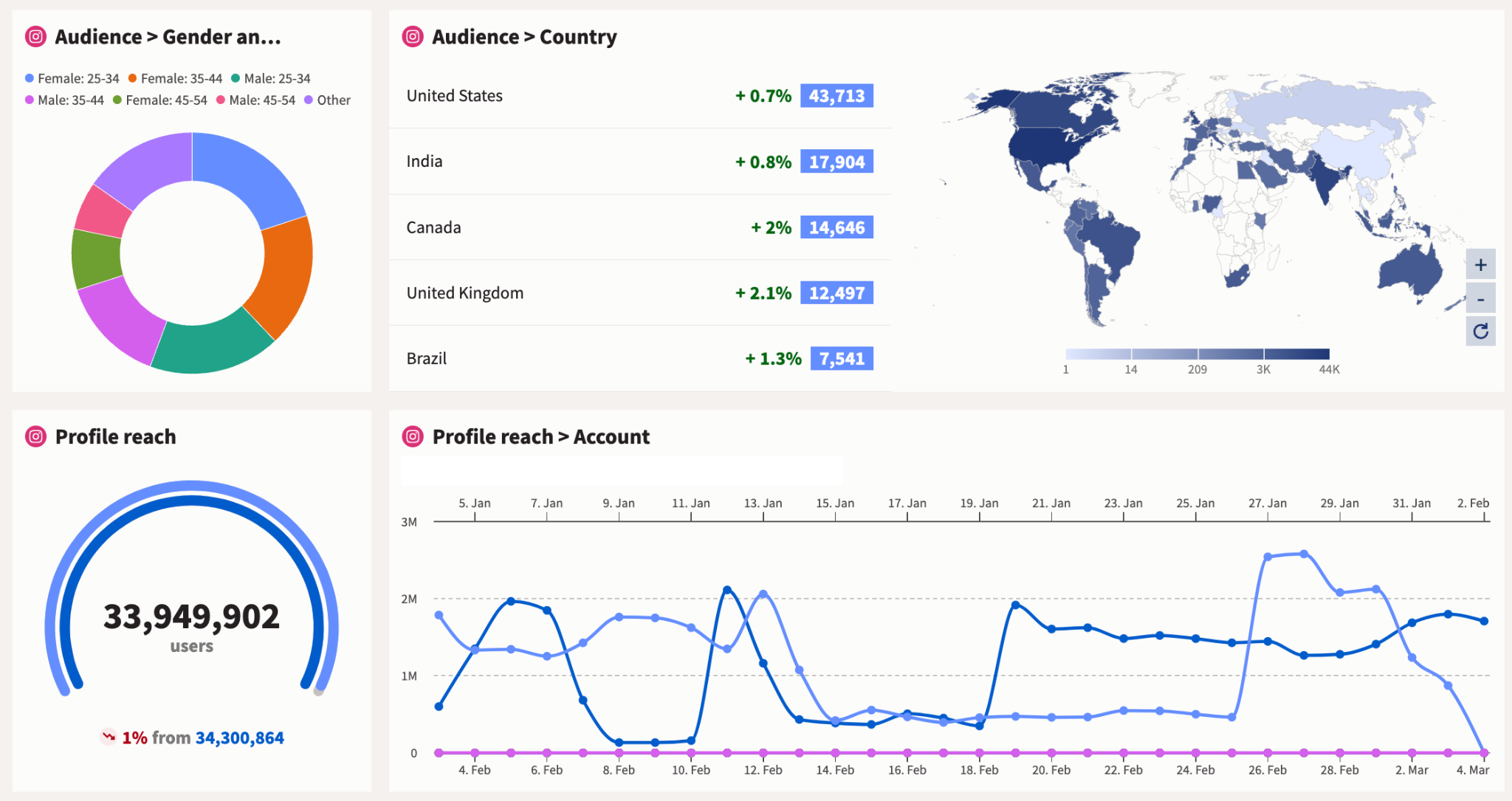
Measurement and optimization
Regularly review analytics across platforms to see what’s working and what’s not. Then, turn insights into action. Adjust strategy, reallocate budget, and share learnings across departments.
With Hootsuite analytics, you can:
- Measure results across multiple regions and social media channels
- Create reports in minutes
- Get automated insights to improve your strategy
You can also analyze your ROI at a glance.
The ability to adapt
Your social strategy shouldn’t be set in stone. Things happen, like budget cuts or shifting trends, and you need to be able to roll with the punches.
“No matter how big the business, resources will always run tight at times,” says Wiles. “My biggest advantage is the ability to be scrappy and look inward to find new content opportunities.”
“That means partnering with new teams that can inform content. Or exploring internal influencers who want to build their own channels, and internal creators or consumers who just enjoy social media. I always try to hear out a ‘random idea’ because you never know what it can spark.”
How do you build an enterprise social media strategy?
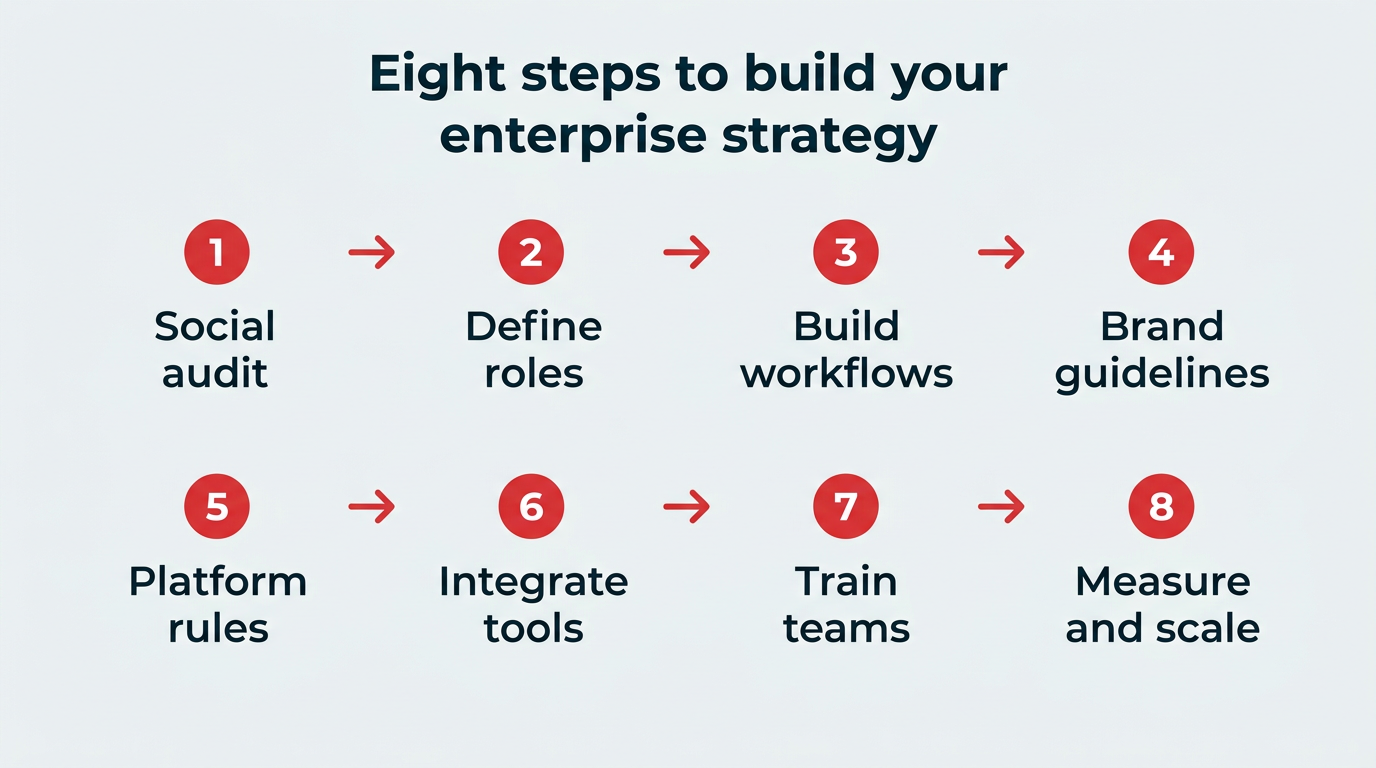
Building an enterprise social media strategy is an eight-step process. Here’s the quick version before we break each step down in detail:
- Conduct a social audit across teams
- Define roles and responsibilities
- Create workflows for approvals and publishing
- Include brand and content guideline use
- Establish platform and publishing rules
- Integrate the right tools and data systems
- Train your teams
- Measure, iterate, and scale
Step 1: Conduct a social audit across teams
Take stock of every existing social account, campaign, and owner. Identify gaps, duplicate pages, and any off-brand activity. Use your audit to see where your audiences are most engaged and where budget isn’t pulling its weight.
Step 2: Define roles and responsibilities
Create an organizational chart and clarify who handles what.
For example, your social org chart could look like this:
Center of excellence (CoE)
A central team sets the vision, voice, and guardrails. They manage global strategy, governance, tools, and reporting.
Example roles with responsibilities:
- Global Social Director: Sets global vision, goals, and governance for all social activity.
- Social Strategy Lead: Develops strategy frameworks, playbooks, and social media campaign direction.
- Brand & Content Manager: Oversees brand voice, messaging, and creative standards across channels.
- Paid Media Manager: Plans and optimizes paid campaigns across markets.
Regional or business unit teams
Local teams adapt global content for their markets. They run the day-to-day and report results back to the CoE. This team keeps content culturally relevant without straying from brand standards.
Example roles with responsibilities:
- Regional Social Manager: Local owner of strategy execution, content planning, and team coordination. They may own the posting schedule.
- Content Creator: Produces on-brand posts, visuals, and regionally relevant content. This could be a copywriter or designer, or both.
- Paid Campaign Specialist: Executes and tracks regional paid campaigns in line with global guidelines.
- Community Manager: Engages with followers, handles comments, and monitors local sentiment.
Cross-functional partners
Marketing, PR, customer service, HR, and compliance teams all play a role in keeping campaigns, customer care, and approvals aligned.
Cross-functional collaboration can be your secret weapon for amplifying social impact. Enterprise organizations should treat marketing as an interconnected ecosystem.
Your email strategy should support your social strategy. That should support your content strategy, which should support your broader brand goals. And so on.
“Social media is great, but it can’t do everything,” says Wiles. “Consider collaborating with other teams, like email and sales. Expand to channels that can support social content variety.”
“I’ve been lucky enough to support relevant podcasts, short series, and experiential activations. These allow us to connect with our audience in a deeper way and bring some freshness to our feeds.”
Employee advocates
Trained employees magnify brand content through tools like Parliament, the employee advocacy app in Hootsuite Social OS.
Step 3: Create workflows for approvals and publishing
Establish standard processes for content creation, review, and sign-off.
Use your social management platform to automate workflows and maintain visibility across teams.
Step 4: Include brand and content guideline use
Your enterprise should already have a brand voice and visual identity. You need to translate these into how these should (and should not) be used on social media.
This is especially important for international brands that have different regional teams. Take some time and collaborate with a regional rep. Work on translating your global brand into localized examples.
Step 5: Establish platform and publishing rules
Document content type, posting cadence, and engagement rules for each platform. Be sure to include:
- Platform best practices
- Accessibility practices like alt image text
- Compliance and regulatory rules
Compliance rules may change depending on where the brand is being executed. For example, data privacy in the UK is different from the USA. Be sure to have your legal team weigh in here.
Step 6: Integrate the right tools and data systems
The right tools and systems will help you automate those pesky tasks you don’t want to spend time doing. This could be compiling reports or getting a bird’s-eye view on your total accounts.
Unified dashboards let leaders track performance across channels and regions in real time. Through MCP connectors, you can also link your social platform to CRM, BI, and AI tools, so data and context flow between the systems your teams already use.
Step 7: Train your teams
Once your social strategy is ready, don’t just slide it into your teams’ inboxes. Take some time to walk through the document to make sure you’re all on the same page.
This is especially important with global teams, who may operate outside of your time zone. Nothing slows down progress like having to wait for leadership to wake up.
Want to empower your employees to post without your oversight? Offer ongoing training on compliance, accessibility, and platform best practices.
Step 8: Measure, iterate, and scale
Set regular review cycles to analyze results, share insights, and refine strategy. Are you meeting your social media goals? Your data has the answer as to why or why not.
A great enterprise social program evolves with your business. It’s driven by data, not guesswork.
How to choose the right enterprise social media platform
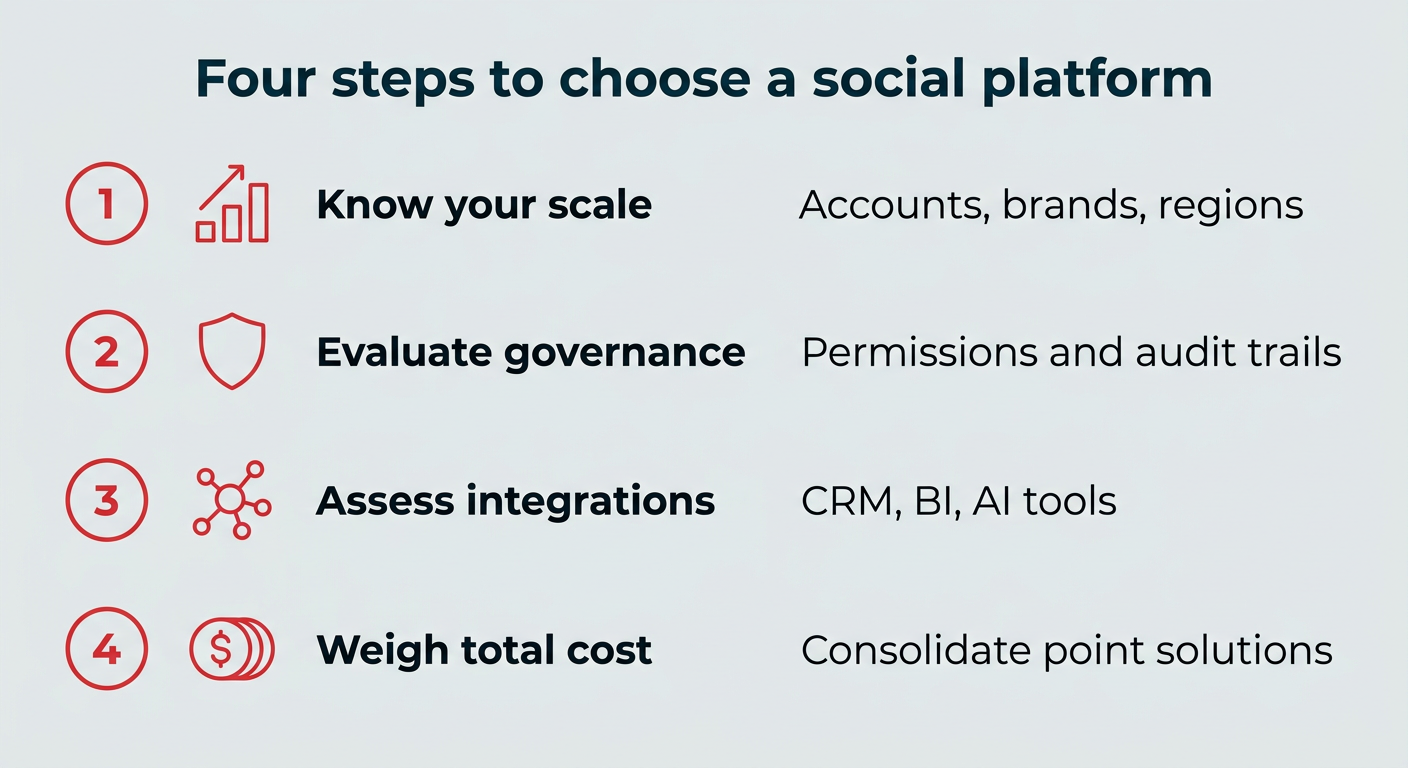
Choosing the right enterprise social media platform comes down to matching the tool to your scale, your governance needs, and your existing stack. The wrong choice leaves you with fragmented tools and workflows. The right one consolidates them, which is why Gartner now treats management and listening as one market. Use this four-step framework to evaluate your options:
- Know your goals and scale requirements: Map how many accounts, brands, regions, and users you need to support. A platform that works for one team may buckle under global scale.
- Evaluate governance and compliance capabilities: Look for granular permissions, customizable approval flows, and audit trails. For regulated industries, confirm the platform supports archiving and compliance integrations.
- Assess integration depth: Check how well the platform connects to your CRM, BI tools, content libraries, and AI systems. Deep integrations reduce manual work and keep data consistent.
- Consider total cost of ownership: Consolidating multiple point solutions into one platform often lowers overall spend and simplifies procurement. Factor in the cost of the tools you can retire.
Once you know what to look for, evaluating specific tools gets a lot easier.
What tools support enterprise social media management?
At the enterprise level, success depends on having the right technology stack. You need tools that simplify collaboration, protect your brand, and deliver actionable insights.
Essential platform capabilities
An enterprise-ready social media platform should make it easy to:
- Manage multiple accounts and teams in one place
- Set customized permissions and governed workflows
- Maintain consistent branding across regions
- Understand audience sentiment through AI-powered listening
- Orchestrate AI across content, care, and insights
- Integrate with your existing tech stack
- Track performance and ROI through unified social media analytics
“In enterprise, you need to go deeper than just general social listening,” says Wiles. “We lean on customer support data to identify pain points and areas of messaging opportunity that will keep content valuable and fresh.”
How Hootsuite Social OS supports enterprise teams
Hootsuite Social OS is built for complex organizations with global reach and varying stakeholders. It gives teams structure, formats, and visibility, so they can collaborate effectively and protect the brand.
Key apps and features include:
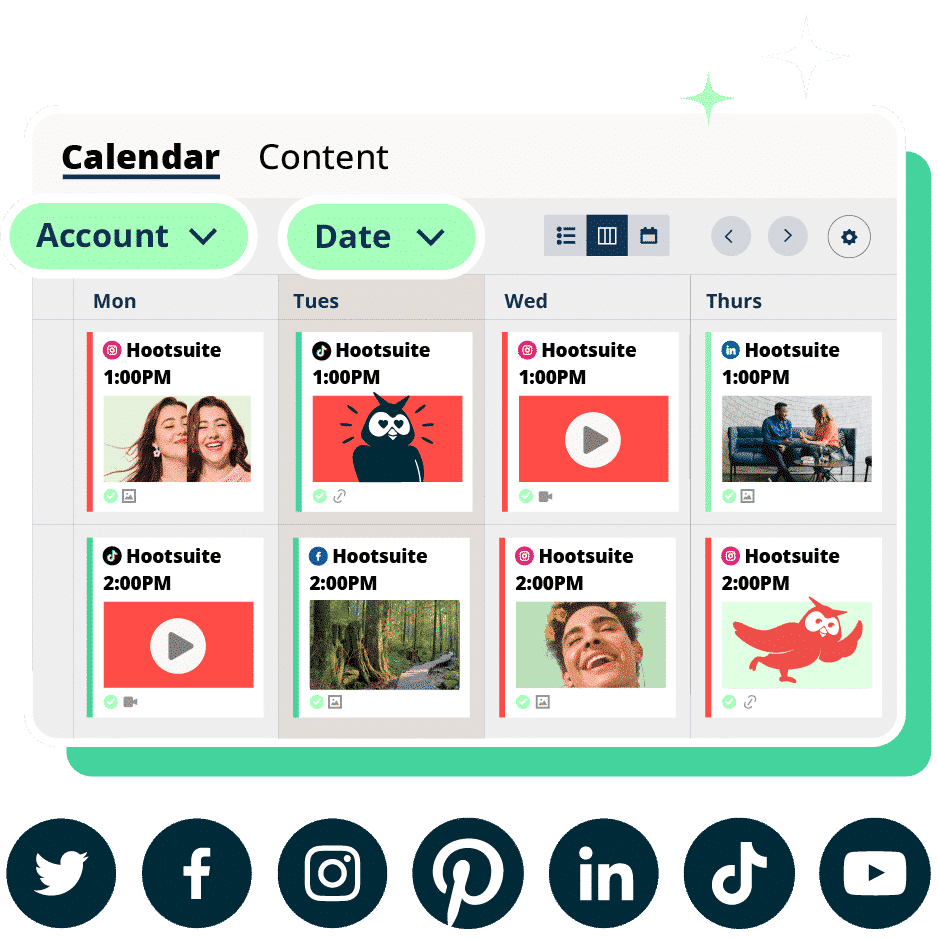
- Perch: Plan, schedule, and publish content across every network from one place.
- Nest: Manage customer care and conversations at scale, with sentiment-based prioritization.
- Lumen: Turn AI-powered listening into insights your teams can act on.
- Parliament: Empower employees to amplify brand content through advocacy.
- Wisdom: Orchestrate AI across content, insights, and workflows.
- Vigil: Keep publishing and AI outputs compliant and traceable.
- Team permissions: Control access by region, brand, or role to keep accounts secure and organized.
- Approval flows: Streamline publishing with customizable review and sign-off processes.
- Content library: Store pre-approved assets and templates to maintain brand consistency across teams.
- Analytics dashboards: Get a unified view of performance across platforms, markets, and campaigns.
- Compliance integrations: Stay compliant with built-in tools and integrations for archiving, security, and risk management.
Ecosystem tools that complement your platform
Your social platform doesn’t work in isolation. Most enterprises connect it to a wider ecosystem of tools that support the full customer and content lifecycle. Common categories include:
- CRM: Salesforce and similar tools connect social-driven leads and conversations to your sales pipeline.
- Business intelligence: Tableau and Domo bring social data into broader company reporting.
- Content and creative: Canva and Brandfolder help teams produce and store on-brand assets.
- Project management: Asana and monday.com keep campaigns and approvals on track.
Hootsuite Social OS integrates with these categories through connected systems and MCP connectors, so your social operating system becomes the hub rather than another silo.
How do enterprises measure social media success?
To measure success at the enterprise level, you need standardization, alignment, and the right tools. Here are the KPIs enterprise teams most often track:
KPI | Definition | Business impact |
|---|---|---|
Share of voice | Your brand’s share of conversation versus competitors | Signals market position and awareness |
Sentiment score | The overall positive or negative tone of mentions | Flags brand health and emerging risks |
Response time | How quickly your team replies to messages | Drives customer satisfaction and retention |
Social-attributed leads | Qualified leads sourced from social channels | Connects social to pipeline and revenue |
Employee advocacy reach | Reach generated by employee-shared content | Extends organic reach and lowers acquisition cost |
Content engagement rate | Interactions relative to reach or impressions | Shows what content resonates by market |
Standardizing key performance indicators (KPIs) across markets
Set shared performance metrics that apply to every region or business unit, such as engagement rates, impressions, follower growth, and response time. Choose whatever social media metrics make sense for your strategy.
Then, layer on localized KPIs where needed. For example, regional reach or campaign conversions. This balance helps teams compare results apples-to-apples while staying relevant to their markets.
Connecting social data to business metrics
Tying social data to business metrics takes you out of the vanity metric arena.
Some ways to connect social data to business metrics are:
- Attribution tracking: Connect clicks, conversions, and sign-ups from social posts or ads directly to your CRM or web analytics tools. You’ll see how social drives revenue.
- Lead generation insights: Measure how many qualified leads or demo requests originate. These could be from social channels, campaigns, or employee advocacy programs.
- Customer care metrics: Track how social interactions impact customer satisfaction scores, response times, and retention rates. Retention rates can be directly tied to revenue.
- Talent and recruitment data: Link employer brand engagement to job applications, hires, and employee advocacy participation. You can link advocacy program participation to employee retention rates. These result in reduced recruitment and training costs.
- Brand health analysis: Sentiment analysis and share of voice can show you how social activity influences brand perception.
Communicating social media impact to stakeholders
Besides how social betters the bottom business line, stakeholders want clarity and realism. As Wiles puts it, “The first step is to be honest about your capabilities and flexible with your goals depending on the support you have or don’t have.”
Ideally, paid support helps you prove you’re reaching the right demographics and driving value. “But if that fails, implement a test and learn approach to find what works organically and scale from there,” notes Wiles.
“When it comes to hard results, if you’re not able to deliver ROI or conversions directly, consider goals that show how social is supporting immediate KPIs, but also learnings that can improve future work.”
FAQ: Enterprise social media strategy
What is enterprise social media?
What is an enterprise social media strategy?
What makes it different from a standard strategy?
What is the difference between enterprise social media and an enterprise social network?
Who should own enterprise social strategy?
How does AI support enterprise social media management?
What are the biggest challenges of enterprise social media?
How do you measure enterprise social ROI?
What tools do enterprises use for social media?
How do global brands manage multiple markets on social media?
Save time managing your social media marketing strategy with Hootsuite. Publish and schedule posts, find relevant conversions, measure results, and more â all from one dashboard. Try it free today.
The post How to build an enterprise social strategy in 2026 appeared first on Social Media Marketing & Management Dashboard.
* This article was originally published here To read more articles like this visit us at yourdigitalmarketingbootcamp.blogspot.com