Social media and politics: Rules and best practices
Whether you like or loathe it, social media has completely changed how politics work.
In this guide, we break down the role of social media in politics today, along with key stats, rules, and best practices to help you navigate it.
Key takeaways
- Social media helps decide what’s trending. It influences what issues people see, discuss, and care about.
- It’s a powerful campaign tool. Politicians use social media to reach voters directly, test messaging, and mobilize support.
- It can also increase political polarization. Social media can spread misinformation quickly, reinforce echo chambers, and amplify misleading content.
- Social media platforms create the rules for political content. Some allow targeted political ads, while others restrict or ban them entirely.
- Social media moves fast, especially in politics. Tools like Hootsuite help teams track conversations, manage content, and respond in real time.
Social media and politics: Stats and facts
1. Political advertisers spent over $1.9 billion on digital ads during the 2024 U.S. presidential campaign
Meta was the largest ad seller, with more than $1 billion in reported political ads.
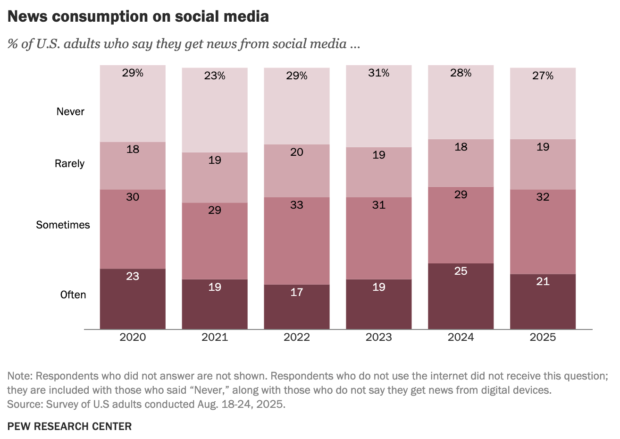
2. 1 in 5 U.S. adults say they often get news from social media
Meanwhile, 32% of U.S. adults say they “sometimes” get news from social media.
Source: Pew Research Center
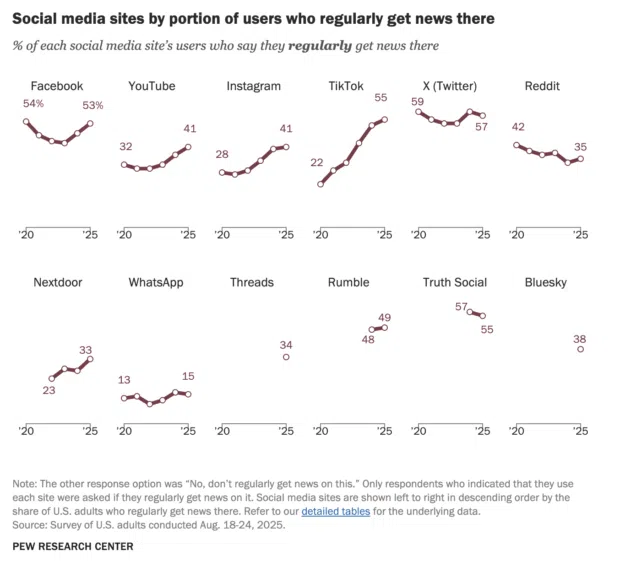
3. 57% of X (Twitter) users use the platform to keep up with politics — the highest of any major network
That’s slightly higher than TikTok (55%) and Facebook (53%).
Source: Pew Research Center
4. 50% of users say social media platforms are important for finding people who share their views
That’s more than those who say it helps them get involved in issues (42%) or express political opinions (34%).
5. Democrats are more likely than Republicans to see social media as politically useful
47% of Democrats say social media helps them get involved in issues, compared with 37% of Republicans.
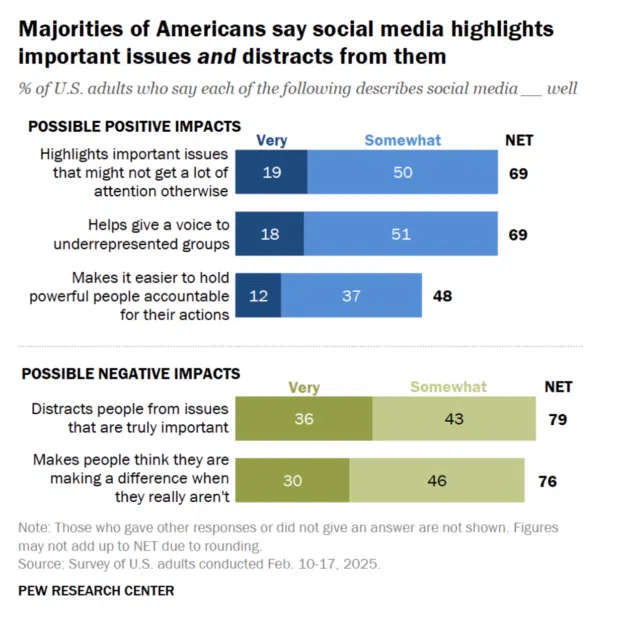
6. The American public is skeptical about social media’s impact
76% say social media makes people think they’re making a difference when they really aren’t, and 79% say it distracts from important issues.
Source: Pew Research Center
How does social media affect politics?
Social media affects politics by influencing how people get news, form opinions, and engage with political news and candidates.
Here’s are a few key ways social media is impacting politics:
Social media is becoming a news source
There’s no denying the influence of social media on how people consume news.
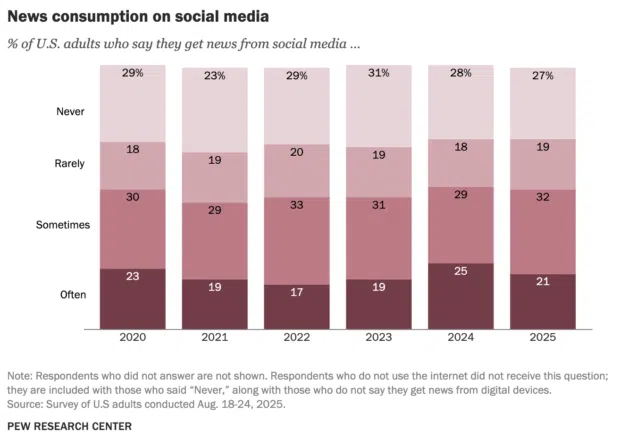
About half of U.S. adults (53%) say they at least sometimes get news from social platforms, and that number has stayed fairly consistent in recent years.
Source: Pew Research Center
On top of that, younger audiences are even more likely to rely on platforms like TikTok, Instagram, Reddit, X, and Snapchat to stay informed.
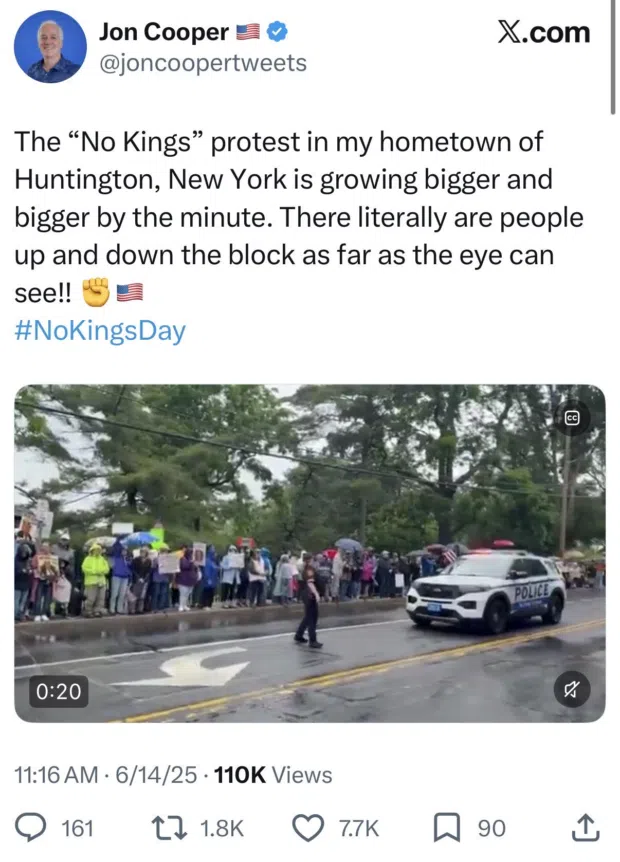
But social media isn’t just for consuming the latest headlines. It’s also where news breaks.
In recent years, major stories have gained traction through viral posts or eyewitness footage before being picked up by traditional media outlets. For example, on-the-ground videos — like protests and natural disasters — often circulate on social media before appearing in mass media.
Source: @joncoopertweets
See the latest data and discover the top social media trends specific to government — and craft a strategy that will delight and engage your constituents.
Get the reportSocial media has given rise to news influencers
Social media hasn’t just changed how people get news. It’s also changed who they get it from.
38% of adults ages 18 to 29 say they regularly get news from influencers.
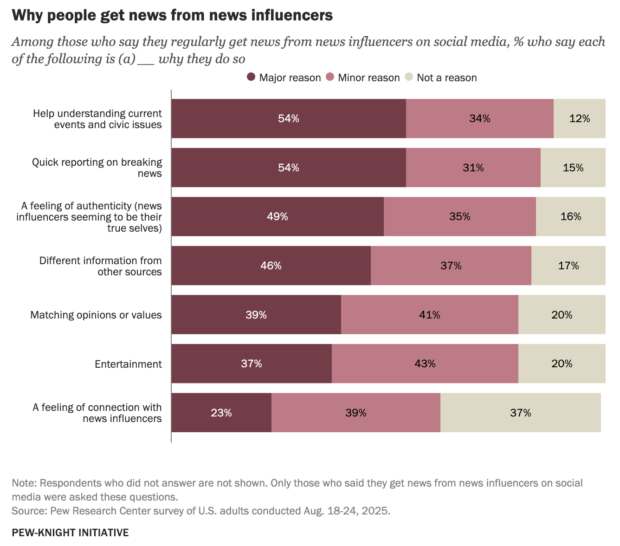
A lot of the appeal comes down to how influencers communicate. Among people who get news from influencers, 54% say it helps them better understand current events. Others say influencers feel more authentic (49%) or offer perspectives they don’t see elsewhere (46%).
Source: Pew Research Center
Thanks to social media, it’s easier than ever for these creators to build an audience and have a real say in political conversations.
Social media is a direct way to reach younger audiences
More than half (53%) of social media users under 30 say social media is important for getting involved in political or social issues.
This matters because younger voters aren’t a niche group anymore. Gen Z and Millennials now make up roughly 40% of American voters.
For politicians, social media is where they can build awareness with younger demographics and stay visible between election cycles.
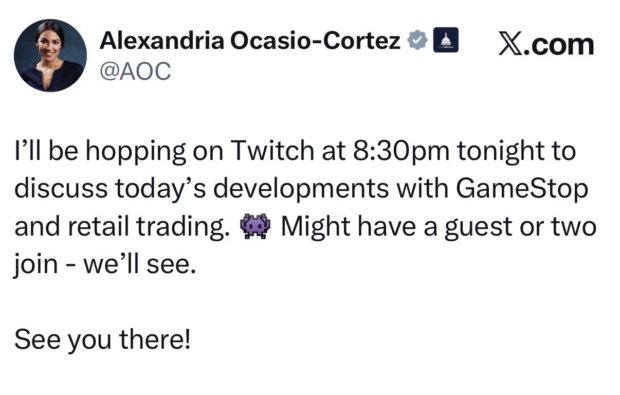
For example, New York Representative Alexandria Ocasio-Cortez (AOC) regularly livestreams on Twitch to discuss hot topics and chat with audiences directly. And it pays off: one of her streams became the fifth most-watched Twitch stream ever.
Source: @AOC
Social media can help increase voter participation
Get-out-the-vote (#GOTV) and voter education campaigns have become a staple on social media. Since these efforts often focus on younger voters, social platforms are a natural place to reach and mobilize them.
Organizations like Rock the Vote have leaned heavily into social to do exactly that. Since its founding, the group has helped register more than 14 million voters, with digital campaigns now playing a central role in driving participation.

Grow on social media while avoiding security and compliance risks. Learn how to connect with your constituents, collect feedback, respond to crises, and more.
Watch nowRules and regulations for a social media political campaign
Rules for political ads on Facebook and Instagram
Meta has strict rules for ads related to “social issues, elections, or politics,” including content about candidates, referendums, ballot initiatives, and election campaigns.
To run these ads, advertisers need to go through an authorization process, which includes verifying their identity and location. (Psst: you must live in the same country where your ads will run)
Advertisers also need to include a clear disclaimer showing who paid for the ad, which users can view through the “About this ad” button.

Source: Facebook
Rules for political ads on X (Twitter)
Rules for political ads on X vary by country. In many regions, they’re not allowed at all.
However, in places like the United States and the United Kingdom, political ads are allowed as long as they:
- Do not include misleading or false information
- Comply with disclosure and content laws
In the U.S., political campaign ads can only run through Promoted Ads and Follower Ads. Advertisers also need to be based in the U.S. and get pre-approval before launching campaigns.
Rules for political ads on TikTok
TikTok doesn’t allow paid political ads. That also includes paying creators to produce branded political content.
TikTok bans for government employees and devices
Many governments and government agencies have outright banned TikTok on workplace devices, or even on employees’ personal devices if they are also used for work purposes. This includes at least 25 U.S. states, all U.S. government agencies, the U.S. Senate, the Government of Canada, and the European Commission.
This impacts many political campaigns, especially those run by incumbents whose staffers are government employees. Before creating a TikTok account — or even downloading the app onto your device — check with your employer to see if you fall under a TikTok ban.
For more details on using social media after being elected, check out our posts on social media and government and social media compliance.
Engage citizens with the only tool that makes it easy to communicate, deliver services, and manage crises.
6 tips for running an effective social media political campaign
Running an effective political campaign on social media is about posting with intention.
Here are 6 tips to do just that:
- Know where your audience is active
- Post consistently
- Use social media for fundraising
- Post content that’s easy to reshare
- Use social media to get journalists’ attention
- Adjust your tone for each platform
1. Know where your audience is active
Any effective social media campaign begins with audience research. Where is your audience spending most of their time on social media?
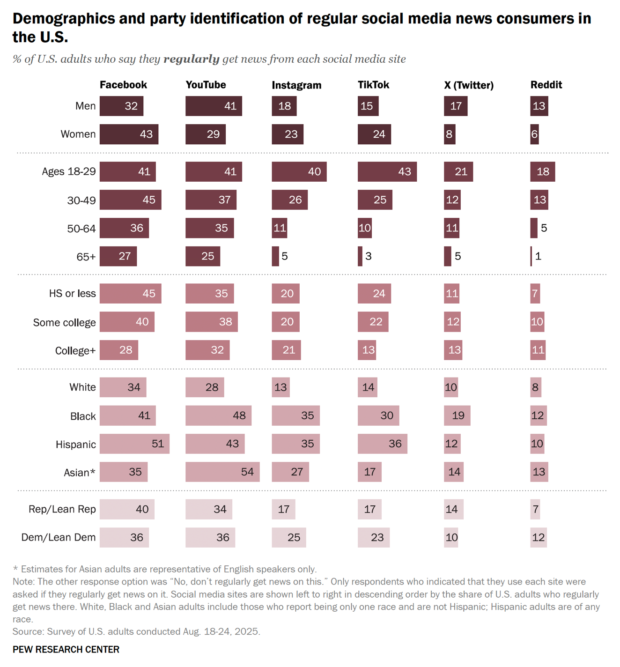
The chart below from Pew Research is a good place to start. For example, Facebook and X have larger representations of Republican and Republican-leaning voters, while Instagram and TikTok are preferred by Democrats.
Source: Pew Research Center
A solid social listening strategy will help you better understand who is already talking about your candidate or social issue online, and which platforms they’re using.
2. Post consistently
It’s tempting to go all-in right before an election, then go quiet. But that kind of stop-and-start approach can lead to audience fatigue (or worse, followers tuning you out).
A content calendar and posting schedule can help you stay active without overwhelming your audience. You’ll likely ramp up closer to key moments, but showing up regularly keeps your audience engaged over time.
Of course, this can be a challenge for grassroots campaigns and candidates with a limited team. Social media scheduling tools like Hootsuite can help make the most of your time by allowing you to bulk upload content and schedule social media posts in advance.
Hootsuite also provides customized recommendations on the best time to post, so you can get the maximum attention for your efforts.
3. Use social media for fundraising
Social channels are an important arm of any political fundraising strategy. Try a link to your donation platform in your bio, and create content that explains how donations are used to further your political goals.
You can also use the “Donate Now” call-to-action button in Meta ads to bolster your fundraising campaign.

Source: BC Green Party on Facebook
Note that TikTok is an important exception here. TikTok policies prohibit campaign fundraising in any form. Specific examples from TikTok include: “a video from a politician asking for donations, or a political party directing people to a donation page on their website.”
4. Post content that’s easy to reshare
On X, about 10% of users generate around 80% of posts. In other words, most people engage by resharing or reacting rather than posting original content.
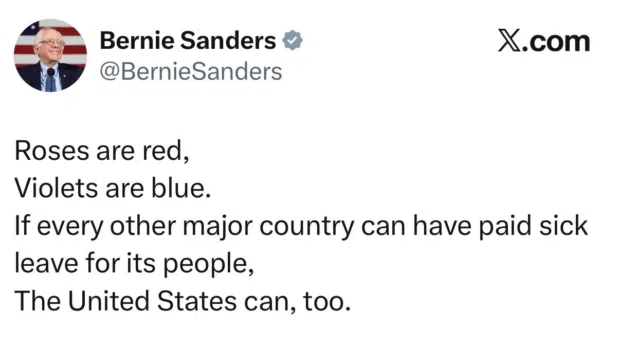
Make it easy for people to amplify your message with social content and relevant hashtags that are fun (or inspiring) to share, whether that’s a quirky Tweet:
Source: @BernieSanders
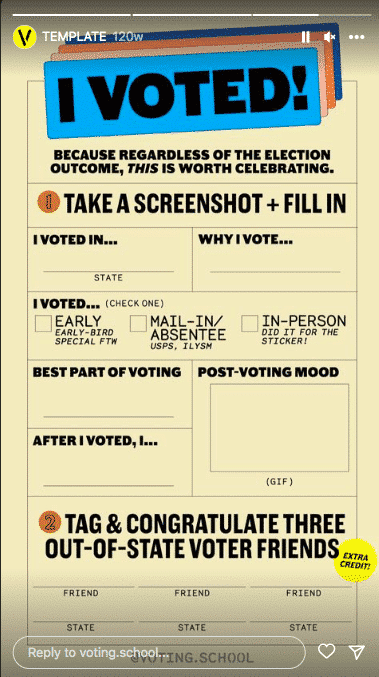
Or a shareable Instagram story:
Source: @voting.school
5. Use social media to get journalists’ attention
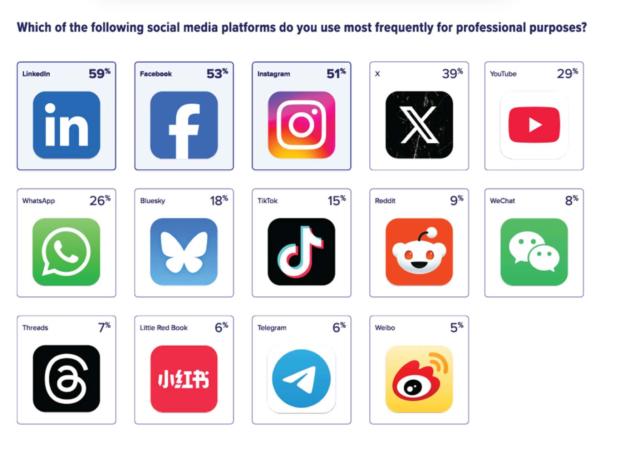
96% of journalists say they use social media for work, whether that’s finding sources, tracking breaking news, or sharing stories.
And they don’t rely on just one platform. LinkedIn, Facebook, Instagram, and X are the most popular platforms among journalists.
Source: Cision
If you’re trying to make or break news in the digital age, social media is often the first step. Stories that pick up momentum online are more likely to be noticed, reported on, and amplified by journalists.
6. Adjust your tone for each platform
User demographics vary significantly among the social platforms. So, it’s important to test your tone and messaging on each platform you plan to use.
Rather than posting the same content to all your social accounts, use custom cross-posting that tailors your content and messaging to each platform. Put a social media testing plan in place to refine your platform-specific strategy over time.
FAQ: Social media and politics
How does social media influence politics and public opinion?
How do governments and political organizations use social media strategically?
What are the risks of social media in political communication and misinformation?
How do platforms regulate political content and ensure compliance?
Social media and politics: what role do platforms play in elections and civic engagement?
Save time building a smart presence — and an engaged audience — on social media with Hootsuite. From a single dashboard, you can:
- Plan, create, and schedule posts to every social network
- Track relevant keywords, topics, and accounts
- Stay on top of engagement with a universal inbox
- Measure the impact of social media campaigns
- Get comprehensive performance reports and improve your strategy as needed
The post Social media and politics: Rules and best practices appeared first on Social Media Marketing & Management Dashboard.
* This article was originally published here To read more articles like this visit us at yourdigitalmarketingbootcamp.blogspot.com